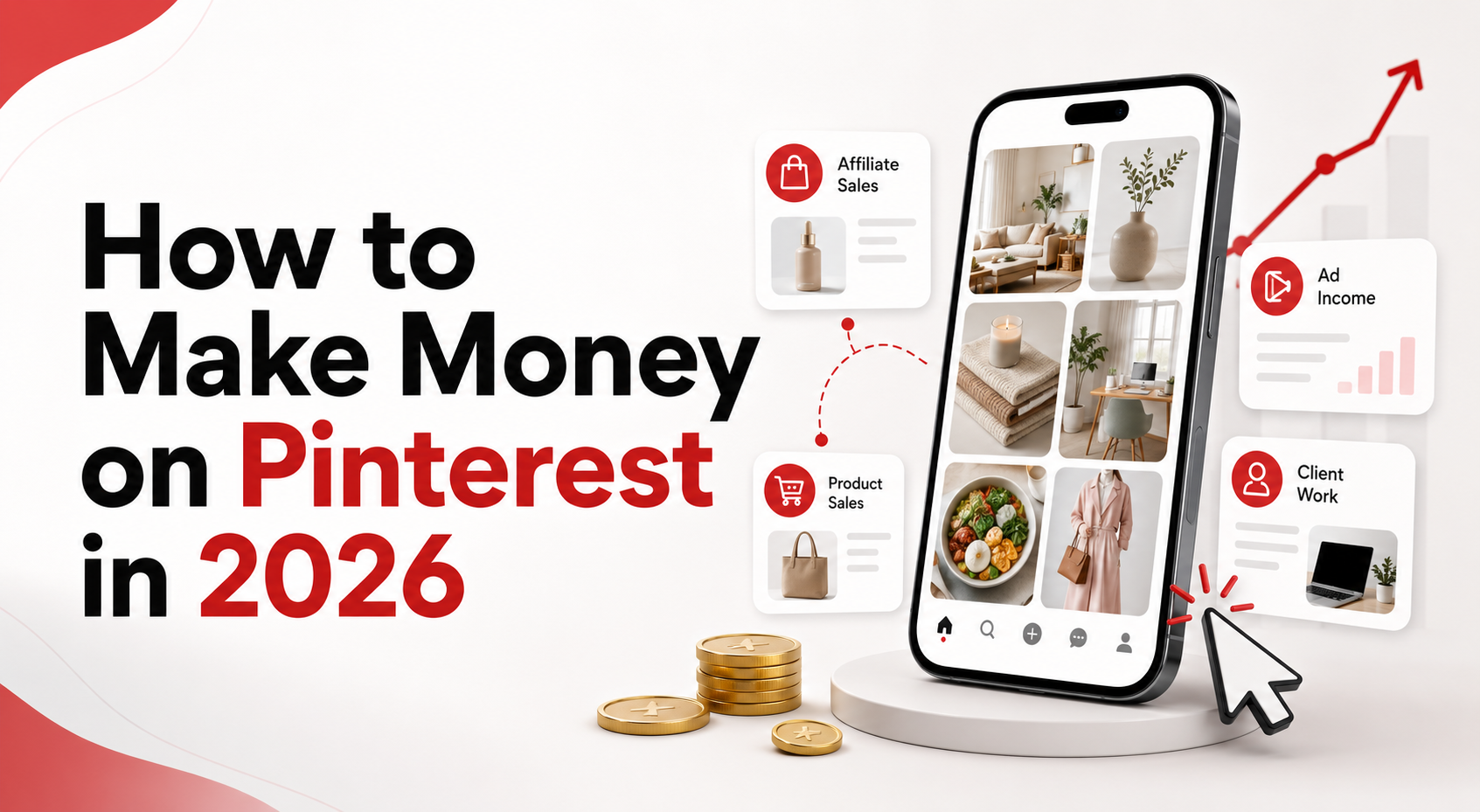
Pinterest has not traditionally offered a payout just for having your Pins viewed. Rather, Pinterest can generate revenue by establishing connections between people and products, content and businesses on or off the site. There are several monetization strategies such as affiliate commissions, selling your products, promoting traffic to a monetized website, leads to services, and collaborating with brands.
The easiest way to explain how Pinterest monetize is discovery to revenue: Pinterest discovery -> Pin -> outbound click -> destination -> conversion -> revenue. One may not know that this difference is significant as a Pin with 100,000 impressions does not necessarily make higher profits as compared to one with 10,000 impressions. The key is to ensure the message is delivered to the right people, effectively gets them to take the next step and ultimately leads to a sale, commission, lead, or other desired action.
Which Pinterest Monetization Method Should You Choose?
The best approach to monetizing will be determined by your current assets. An individual with no product or site may research affiliate marketing, if the rules allow it, or advertise a service that they can offer. Bloggers can direct traffic to helpful blog posts on Pinterest that can earn income from ads, affiliate earnings, or product sales. An ecommerce business can create product and problem-focused Pins that lead potential customers towards its existing products.
A 2nd option for people who have valuable knowledge and/or experience is to sell digital products or services. Later, once the creator has a following that’s interested in the content, he or she might eventually partner with a commercial brand and/or sell his or her own products.Eventually, if the creator has a following that’s interested in the content, he or she may be able to sell his or her own products and/or partner with a commercial brand for affiliate marketing. To start, newbies ought to pick a strategy that makes sense with regards to what Pinterest users are searching for and what they can genuinely give.
How to Make Money on Pinterest Step by Step
1. Create a Pinterest Business Account and Focus Your Profile
You can create a Pinterest business account for free, with Pinterest Analytics and more business features. Your profile should also convey a definite theme. Employ an accurate name and description and make boards that help the topics you really want to do.
For instance, an apartment organization or renter-friendly business can make boards on small bedroom storage, apartment organization, or whatever else instead of filling up its profile with dozens of unrelated topics. If you are depend on your own website, you may even want to take the opportunity to claim it on Pinterest. Claiming a website allows users to link their profile to Pins with content from their site and offer them more information about the content being shared.
2. Check Whether Your Topic Is Relevant on Pinterest
When choosing a niche, think about whether people are likely to use Pinterest to discover, plan, compare, learn about or buy products that are related to the niche. The topic should also provide you opportunities to produce useful visual content related to problems, interests or goals that you can identify. Most importantly, there should be some logical end point after the discovery, be it an useful article, a product or service, or any other monetizable resource.
Assume that you are selling a budgeting spreadsheet. There is a natural link between that product and searches involving paycheck budgeting, organizing monthly bills and household budget categories. The freelancer could work in other ways when designing useful content based on the design problems that potential customers are exploring and then channel potential customers to an appropriate service page. In both the business opportunity is business is in finding a real user need and making it useful, not picking a topic just because it looks like it could be lucrative.
3. Research Relevant Pinterest Searches
Pinterest Search can give you insights on how your subject is being explored by users. Begin with a general subject and look at the search suggestions and what kind of content is being displayed in the search results. When seasonality is important, Pinterest Trends can offer more insights into the shifting interest in topics.
Specificity for search is a key point. The person looking for “beautiful bedrooms” might just be looking for inspiration, while the person looking for “small bedroom storage ideas” definitely has a problem. When selling storage products, it will be easier to give a helpful article, comparison or product with the second search. This doesn’t necessarily imply that all keywords are going to have immediate buying intent. It implies that the search should be relevant to your overall search process to get to your desired monetization strategy.
4. Create Pins That Match the Search
It’s good to have a useful pin, one that will give someone a fairly good idea of what they will get when they click. A title like “Products I Love” doesn’t give much context, and “10 Small Kitchen Storage Products for Apartments” is much clearer about the audience, the piece is likely to be aimed at and the subject.
The visual and headline should grab attention and not give false hope for what they will find on the destination. Pinterest favors top-notch visual content, and frequently suggests that the ideal aspect ratio for Pin creative is 2:3. It’s also possible to make different Pins for the identical helpful destination, provided that each one provides an unique perspective. For instance, a guide to organizing the small kitchen may feature their own Pins concentrating on budget storage, renter-friendly tips for organizing and storage in a very small kitchen.
Affiliate Marketing vs Selling Your Own Products
Affiliate Marketing on Pinterest
Affiliate marketing is a strategy in which you can make a commission when someone converts into a preselected transaction or other event as a result of your affiliation. The first question to ask is whether the product really appeals to your target market. Another question to ask is if the affiliate program allows for Pinterest or social media marketing, if direct affiliate linking is allowed, which countries the merchant targets, how the commissions are calculated and how the referrals are assigned.
The next content should be about the kind of search where the followed product actually can help. For instance, if a person is looking for “best compact treadmills for apartments” they are weighing choices. A Pin might be used to take that person to an article that is useful, with an article that contains some affiliate recommendations that are relevant, instead of immediately driving someone to a single product without context.
Disclosure of affiliate relationships should be done properly as well. The Federal Trade Commission recommends that material connections between an endorser and marketer be clearly and conspicuously disclosed when endorsements are made to U.S. consumers. However, affiliate marketers need to ensure that they clearly disclose to the user that a recommendation may involve a fee. Requirements may vary in other jurisdictions and with individual affiliate programs.
Selling Your Own Products on Pinterest
Pinterest isn’t just for those interested in a new way to make money; for businesses that already have physical or online products, it’s a discovery tool you can use without having to start a new line of business. For a budgeting business, they might develop beneficial content focusing on “how to budget every paycheck” and direct pertinent visitors to a budgeting spreadsheet.
In physical product businesses, you can follow a similar approach by developing content around tutorials, comparisons, styling ideas, use cases and problems your products solve, as opposed to just catalogue style images. Pinterest also has shopping capabilities, such as Product Pins and Rich Pins. Product Rich Pins can include any product information from an eligible website, such as price and availability. While these can help make shopping more convenient, they cannot take the place of reaching individuals who are genuinely interested in the topic or product.
How to Make Money on Pinterest With a Blog or Website
Another wonderful thing about Pinterest is that it can redirect users to helpful website information. This might be applicable to bloggers and publishers who earn income from their websites by advertising, affiliate recommendations, electronic products, email advertising or a combination of these techniques.
But it’s not revenue from traffic. A worthwhile article should serve the purpose of why the reader has gone to pin it and also give them a direction to go next. A recipe publisher can generate advertising income from relevant website visitors, and a niche blog can feature informational content to introduce appropriate affiliate suggestions and/or its very own merchandise. Additionally, content, analytics, email capture, and email conversion optimization are enhanced when you have a key stake in the destination.
How Many Pinterest Views Do You Need to Make Money?
There isn’t a set amount of Pinterest views that you will need to earn a profit. An alternative way to think of the economics: impressions x outbound click rate x conversion rate x revenue per conversion = potential revenue.
Suppose there is an imaginary instance. Suppose that a Pin receives 100,000 impressions and 1% of those impressions lead to outbound clicks.Let’s say 1% of the 100,000 impressions on a Pin lead to an outbound click. That would generate 1,000 visits to the Web site. 20 sales would be generated from 2% of those visitors. If there was a $10 revenue for every conversion, then it would be $200.
These percentages are merely assumptions and not guarantees. These aren’t Pinterest benchmarks, expected results or an earnings guarantee. The example is just used to illustrate why just looking at the number of impressions doesn’t necessarily mean you’re able to earn more. If a Pin with less impressions would bring in more qualified clicks or send to a landing page with a higher conversion rate, it could make more money.
How to Track Whether Pinterest Is Making You Money
Knowing what is going on with your content on Pinterest is important, and Pinterest Analytics can help you out there, as well as with content performance and metrics like outbound clicks. When your website is monetized, you’ll also need to know what happens once the user is off of Pinterest.
In the affiliate marketing niche, it could be done by comparing outbound traffic from Pinterest to the conversions and commissions earned by the affiliate program. Pinterest traffic can be correlated with web page or site analytics’ views, carts, purchases and revenues from an ecommerce business. An enquiry or booking can be tracked by a service provider to determine if Pinterest visitors landed on a service page, and then converted to an enquiry or booking; and an email-based strategy can measure landing page visits, signups, and later conversions.
When used correctly, UTM parameters can also ensure that website analytics track traffic from specific Pinterest links or campaigns. Pinterest also offers other measurement products, like the Pinterest Tag, which can measure certain website conversions driven by Pinterest ads. For those who are applicable, Pinterest also provides Conversion Insights with relevant organic and paid conversion data.
What’s key is to know where the breaks are occurring. If Pins are being seen, but not many clicks, look into the topic, search intent, headline and creative. Once users click, but do not convert, try to understand where they are going, what offer they are taking, the pricing, and the user experience and trust signals. This provides more valuable reports than considering impressions as a measure of commercial success.
Do You Need a Website or Lots of Followers?
You don’t have to have your own website to use Pinterest for business. Depending on the features Pinterest has available and the rules for the third-party program, some affiliate programs or service strategies or brand partnerships can be executed without having what is considered a “traditional” website.
But more control over landing pages, content, analytics, email capture and optimization for conversions comes with having a website. It’s especially beneficial for bloggers, publishers and businesses who rely on a strategy of owned content or sales pages.
But a high number of followers is not mandatory either. These clicks and conversions by a smaller number of relevant users can be more commercially valuable than those of a much larger audience with only impressions. There’s also no accurate universal framework for profiting from Pinterest. Depending on the topic, competition, relevance of the search, offer quality and conversion as well as seasonality and variation in offer strength. The claims that offer a specific income after publishing a certain amount of Pins for a set duration often need to be taken with extreme caution.
Can You Make Money With Pinterest Brand Partnerships?
Another avenue for creators to monetise their content is through brand partnerships, where they have a clear niche in their content and an audience that is targeted at their potential partners. There is a paid partnership option on Pinterest where creators can add brands that they already have a commercial relationship with. The deal is done with the brand, not Pinterest that pays the creator based on pin views.
Those who wish to follow this model should be able to prove the subjects of their work, the audience and why the audience is a good fit for the brand. Then there’s the fact that true performance data can assist brands in assessing a partnership. Commercial relationships should be disclosed in accordance with the requirements of the platform and advertising regulations, like affiliate relationships.
Frequently Asked Questions
Does Pinterest Pay You for Views?
In short, yes, Pinterest does pay you for views.
Generally, Pinterest does not pay creators based on the number of views or impressions their Pins get. Revenue typically is derived from a commercial result, like an affiliate commission, product sales, monetized visits to the website, client enquiry, or brand partnership.
Can Beginners Make Money on Pinterest?
Pinterest’s beginners policy allows for the use of Pinterest for commercial purposes, but just being a member does not bring in income. There is still a need for a topic and audience, a legitimate monetization path, valuable content, a suitable destination, and a means to measuring whether Pinterest activity is driving conversions.
Can You Use Affiliate Links on Pinterest?
Each affiliate program may have its own promotional rules, and Pinterest offers the ability to monetize through affiliate programs. Verify the terms of the program(s) before making use of affiliate links on Pinterest and comply with applicable disclosure regulations.
How Often Should You Post on Pinterest?
No set schedule of publication is guaranteed to bring in the money. It’s more helpful to have a sustainable schedule that lets you produce good content that’s relevant to your interests and assess the results of your efforts, than to post low-value Pins to meet some arbitrary daily mark.
Final Thoughts
The bottom line of making money on Pinterest is to tie discovery with a real business goal. Select the monetization strategy that suits your resources best, devise valuable Pins based on topic-relevant search terms and guide users to the promised destination after the Pin.
Then observe the results. When users aren’t clicking, explore the Pin and its link to search intent. If they click but don’t convert, dig up the destination and the offer. It’s not Pinterest’s number of impressions that make it commercially useful, but it’s the results that can be measured.

Muqit is an author at Insiders Desk, creating simple and practical guides to online business and digital income. He writes about business models, digital tools, SEO, content creation, and monetization methods, with a focus on clear explanations, realistic expectations, and informed decision-making. His content is educational and does not promise guaranteed income or business results.