Discover 3 AI side hustles to start in 2026. Compare startup costs, learning time, effort, pricing, demand and risks before choosing one.
3 AI Side Hustles to Start in 2026
Testing AI side hustles is simpler in 2026, since automation, content, and website tools now provide free or inexpensive ways to get started.
This guide highlights three options that offer a clear service to sell, require no advanced coding, and match current demand in the freelance market.
Research method: This guide is based on research rather than being a personal income case study. Costs and features for tools were verified using official documentation from providers. Pricing and demand signals were compared against marketplace data from 2026.
The planning ranges below are editorial estimates for the sample services covered in this article; they are not guaranteed timelines or earnings.
Quick Answer
AI Automation You can get started at no initial expense for practice, though paid tools like Make Core might cost about $12 a month when required. A beginner might require around 15–25 hours of practice, with an estimated weekly commitment of 5–10 hours.
A first client might be found within 3–8 weeks, depending on the quality of your portfolio and your outreach. This choice is ideal for those who like systems, workflows and solving problems.
AI Content and Social Media Management You can also get started at no cost, though optional scheduling tools might run about $5 each month per channel. The learning curve tends to be shorter, requiring roughly 5–10 hours of initial practice and about 4–8 hours of effort each week.
With steady outreach, a beginner can typically land a first client in about 2–6 weeks. This side hustle suits those who like writing, creating content and doing creative work.
AI Website and Chatbot Creation It can be practiced with free tools, though paid website plans, domains, or premium chatbot features might ultimately be needed. Newcomers might require about 15–30 hours of practice and roughly 6–12 hours each week to build and deliver projects.
Finding a first client could take about 3–8 weeks. For beginners who are drawn to design, websites, and technology, this choice is the most suitable.
The practice, effort, and first-client numbers shown are planning estimates derived from the sample offers listed below, not industry benchmarks. A dependable, universal dataset on “time to first client” does not exist.
Upwork reported that in 2026, demand for skills that explicitly mention AI rose 109% year over year, with AI integration growing 178% and AI chatbot development up 71%. By July 2026, “AI automation” had become its most-searched AI term.
These signals reflect demand; they do not guarantee that any particular freelancer will land work.
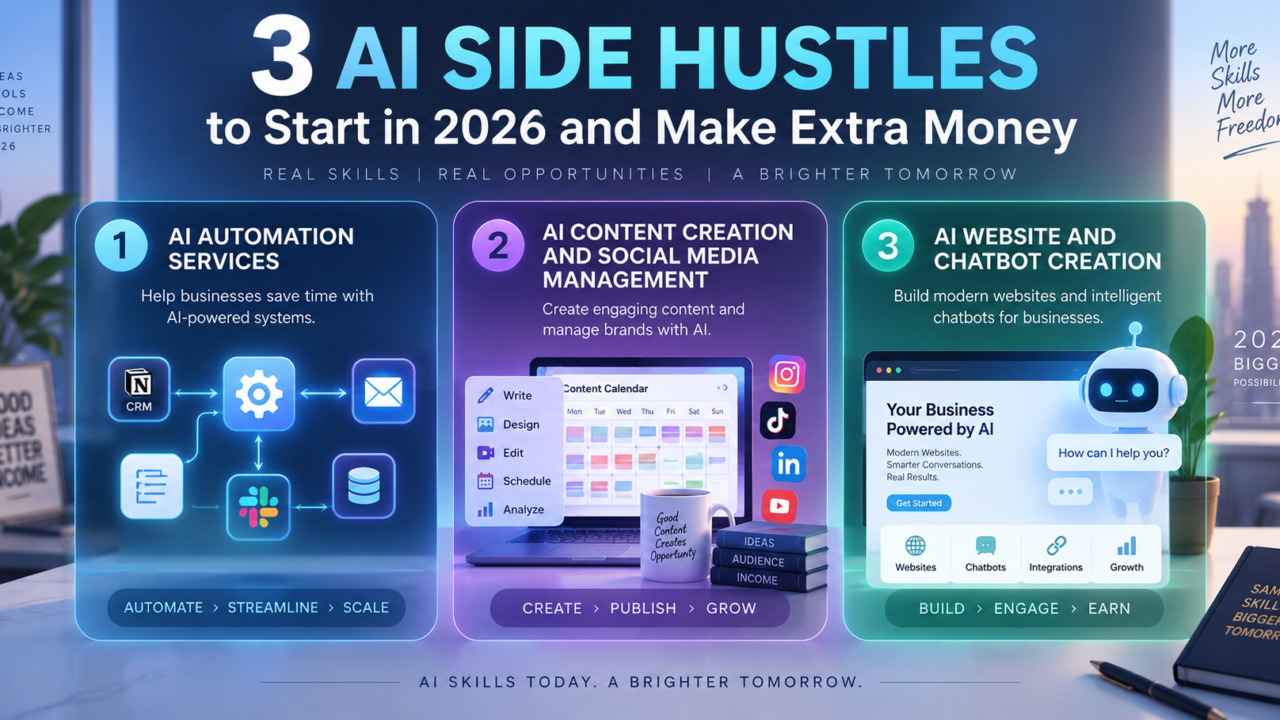
1. AI Automation Services
AI automation involves linking tools together so that repetitive tasks get done with less manual effort. A small business could automate things like lead follow-ups, CRM updates, email sorting, form submissions, or internal notifications.
A beginner offer might look like this:
“I will connect your website leads to your CRM and notify your team automatically.”
The deliverable could consist of one working workflow, testing, basic documentation, and handover.
At present, Zapier’s free plan includes 100 monthly tasks. Make offers 1,000 monthly credits for free, while its Core plan costs $12 per month for 10,000 credits.
This allows for practice without a big upfront budget, though client usage may lead to ongoing software costs.
Pricing and Demand
Right now, Upwork shows Zapier specialists earning roughly $40 to $90 an hour, with single-workflow projects priced at about $300 to $800.
These figures are benchmarks from the buyer side of the marketplace, not amounts a beginner should assume they will earn.
It is simpler to back up demand than to rely on vague labels like “high” or “medium” for competition. According to Upwork, AI automation was its most-searched AI term in July, and Fiverr’s 2026 Business Trends data reported a 125% rise in searches for n8n AI automation.
Automation can bring in one-time project income or recurring support revenue for monitoring, troubleshooting and updates.
Main Risks
Automations may fail when APIs, permissions, fields, or business processes are modified. Access to client data also brings with it privacy and security obligations. The service should include testing, documentation, and account access limited to the minimum necessary.
2. AI Content Creation and Social Media Management
Among these three options, AI content requires the least technical expertise. ChatGPT can help with planning and drafting, Canva provides a free design plan, and Buffer offers free scheduling; Buffer Essentials begins at $5 per month per channel with annual billing.
A practical offer for beginners might look like this:
Monthly Social Media Package
12 posts
Captions
Content ideas
Simple graphics
Monthly calendar
Instead of raw AI output, the client gets a complete, finished content package.
Pricing and Competition
Right now, Upwork shows social media managers earning roughly $14 to $35 an hour. According to Fiverr’s 2026 marketplace data, social-media marketing hourly rates sit at about $47–$108, varying with scope and the type of service. That gap illustrates why marketplace prices should be seen as context instead of a set rate card.
Competition is a real worry. Upwork’s 2026 workforce research discovered that generative-AI and creative-production contract starts rose 90% year over year, even as per-contract earnings dropped 13%. On a separate note, jobs requesting humans to refine AI-generated work grew 70% year over year.
This indicates that basic AI output is getting easier to commoditise, whereas editing, judgment and refinement still hold value.
The biggest risk is inaccurate or generic AI-generated content. Facts, statistics, claims and brand voice still need human review.
3. AI Website and Chatbot Creation
AI-powered website builders and no-code chatbot solutions can lower the technical hurdles involved in straightforward client projects.
Wix lets users create a website at no cost. You need a paid subscription for features like a custom domain; the Light plan shown currently begins at roughly $17.77 a month, though pricing differs depending on your location.
HubSpot likewise provides a free chatbot builder capable of qualifying leads, answering routine questions, and scheduling meetings with no coding required.
An initial offer might be:
Small Business Starter Website
One-page responsive website
Contact form
Basic SEO setup
FAQ chatbot
Lead capture
Client handover
Pricing and Demand
At present, Upwork shows web developers earning roughly $15 to $50 an hour, while chatbot developers are listed at about $30 to $61 an hour.
Fiverr offers a helpful second point of reference: according to its 2026 chatbot pricing figures, basic implementations cost around $50–$200, while more advanced AI chatbot projects typically reach into the hundreds of dollars.
Demand can be measured as well. In its 2026 skills research, Upwork reported that demand for AI chatbot development rose 71% compared with the previous year.
This side hustle can generate one-time setup fees in addition to recurring income from maintenance, hosting support, or chatbot updates.
Main Risks
A website that is ready for clients still needs mobile testing, usability reviews, and precise content. Chatbots may provide wrong responses, whereas premium website packages, domains, and extra software can lead to ongoing expenses.
Which AI Side Hustle Is Best for Beginners?
Pick the option that matches the work you can realistically pick up and deliver.
AI content and social media offer the quickest route to learn, yet basic AI output is under greater price pressure.
AI automation requires more time to learn, since workflows may involve integrations, logic, and handling failures, but present marketplace data points to solid demand for implementation.
AI websites and chatbots fall somewhere in the middle of these two. No-code tools make simple builds within reach, but delivering professionally still demands design, usability, and quality control.
The first-client figures in the table are planning estimates rather than guarantees. Portfolio quality, niche, pricing, outreach, and existing contacts can make the process faster or slower.
How to Start an AI Side Hustle in 2026
1. Choose One Specific Service
A concrete offer is simpler to grasp than marketing vague “AI services.” Begin with automated lead follow-up, a set monthly content package, or a single-page website featuring a chatbot.
2. Learn One Core Tool
Stick with a single main platform until you’re able to finish your sample service without needing tutorials for each step. In many situations, free tiers provide enough for practice; paid features ought to be added only when a project actually needs them.
3. Create 2–3 Sample Projects
When you lack client experience, your portfolio becomes even more important. Create fictional or demonstration projects and label them clearly as samples. Do not suggest they delivered business results that you have not actually measured.
4. Find Your First Clients
Make use of freelance marketplaces, LinkedIn, local directories, professional groups, your network, or direct outreach. Present the sample, describe the problem it addresses, and specify the exact deliverable.
5. Improve the Offer
When actual clients begin asking for comparable work, bundle the deliverables that repeat and include ongoing support only in cases where it delivers real value.
FAQs About AI Side Hustles in 2026
What are the best AI side hustles in 2026?
AI automation, AI-assisted content and social media management, and AI website or chatbot creation are all practical choices, since each offers low-cost entry-level tools, a clear deliverable, and existing demand in the marketplace.
Can beginners make money with AI?
Indeed, yet merely having access to AI does not give you a competitive edge. Those just starting out still require a practical skill, sample work, outreach efforts, and dependable delivery.
Can I start with no money?
All three can be tried out using free tiers. Paid plans typically start to matter once you need client usage, custom domains, higher limits, scheduling, or premium features.
How much should a beginner charge?
There is no standard beginner rate that applies to everyone. Use marketplace benchmarks for reference, then set your price based on scope, complexity, revisions, and proof of skill instead of simply copying the rate of an established freelancer.
How long does it take to get the first client?
No dependable benchmark exists that covers the entire industry. The planning ranges given in this article presume steady practice and outreach, though they may differ considerably.
Are AI side hustles saturated in 2026?
The field of easy-to-produce AI output is more saturated than that of specialised implementation. Data from the current marketplace indicates rising demand for AI integration and chatbots, whereas generative work of lower complexity is under increased price pressure.
Do AI side hustles require coding?
Not in every case. Many basic projects can be managed with no-code tools. For APIs, custom integrations, advanced chatbot logic and specialised website features, coding proves more useful.
Conclusion
AI automation, content services, and the creation of websites or chatbots can all be tried out with minimal upfront expenses, yet none of them ensures earnings.
If you want the quickest route to learning, content and social media make the easiest place to begin. When business problems are more technical, automation brings greater demand for implementation. For work centered on design, websites and chatbots offer a sensible middle option.
Begin with a single clearly defined service, produce genuine sample work, and rely on AI to enhance delivery instead of making AI itself the product.

Muqit is an author at Insiders Desk, creating simple and practical guides to online business and digital income. He writes about business models, digital tools, SEO, content creation, and monetization methods, with a focus on clear explanations, realistic expectations, and informed decision-making. His content is educational and does not promise guaranteed income or business results.