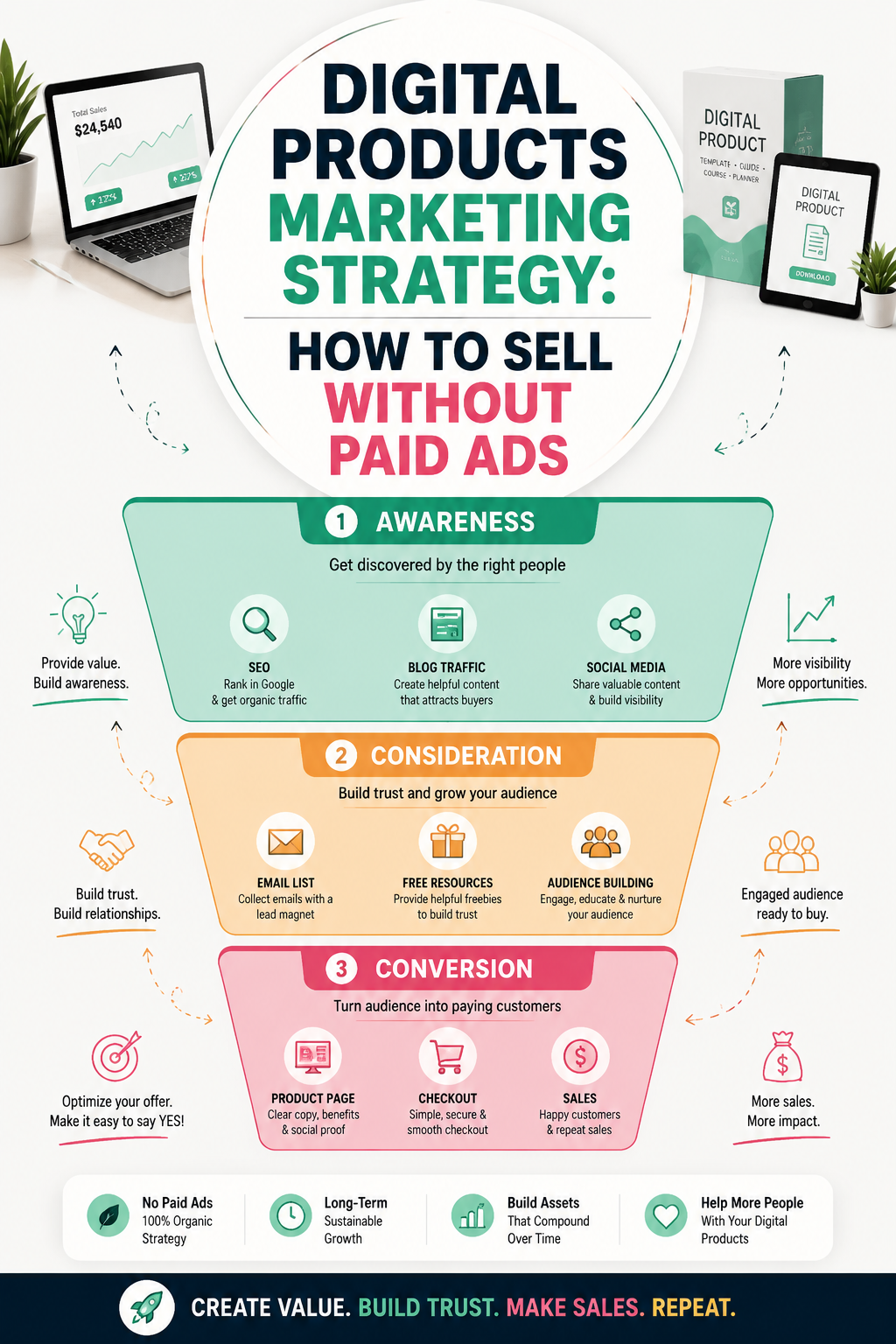
The key to selling without paying is having a solid digital product marketing strategy.
You do not need to pay for advertising to sell a digital product. A digital product marketing strategy can combine relevant keywords, valuable content, email marketing and social media to attract potential buyers and guide them through the sales funnel.
But traffic is not a marketing strategy. Your product should address a problem that is clearly present, provide enough information and confidence to your potential customers that they will purchase it and be able to compete with other products on the market. This means you need to consider the entire journey from initial demand through to purchase, rather than focusing on traffic alone.
One way of tackling this is with a Demand-to-Sale Framework: Demand, Discovery, Decision, Conversion, Diagnosis. Demand asks whether people genuinely need the solution. Discovery focuses on how potential customers will find you. Decision focuses on why a potential customer should choose your product. Conversion is the point at which an interested visitor becomes a customer. When sales don’t occur, diagnosis enables you to determine which aspect of the process is lacking.
Confirm Demand and Position the Digital Product
You do not need to create large amounts of content or spend heavily on promotion before confirming that your digital product solves a problem people actually care about. Identify the people who suffer the problem, how they are currently addressing the issue, what other solutions are available and what benefits your product will offer.
One indicator of the existing demand is search behaviour. Resume templates, budget spreadsheets, educational resources and content planners typically solve issues that people are already looking for. SEO can then be used to get a piece of that existing demand. If the product is new or different, it might not generate any direct search traffic, so content on social media, communities, partnerships and educational sites can be more important to build awareness.
However, demand alone is not enough. You need to know what might make a person pick your product over a competitor, free resource or do-it-yourself product.
Analyse Competing Alternatives
Search the core keywords related to your product and the problem it solves to see what prospective customers are likely to encounter. Analyze the target market, claims made by competing products, product price, what it contains, how it shows the product and customers’ comments about it.
Recurring complaints can reveal gaps in existing products, while positive reviews can show what customers already value. However, if customers continue to complain about the complexity of the template, then simplicity may be a true differentiator. A more specialised product may appeal to a more limited segment if competing products are general.
The goal is not to copy competitors and make superficial changes. You are looking for a clear reason a customer would choose your product over another option.
The term “social media content planner,” for example, is very generic. A planning system designed specifically for social media managers handling multiple clients has a clearer target audience and use case.
A helpful positioning formula is Audience – Problem – Outcome – Difference. The difference should be something the customer can understand and value, rather than simply claiming that your product is “better”.
Build a Digital Product Marketing Funnel Around the Buying Decision
The organic digital product funnel can typically be broken down into awareness, consideration and conversion. These stages help determine what information a potential customer needs depending on how close they are to making a purchase.
Awareness
At the awareness stage, the customer is typically researching a problem or issue rather than looking for a specific business. They can find you on Google Search, Pinterest, social media, communities, recommendations or on another website.
Your content should clearly answer the immediate question and provide a next step for interested readers. If someone is looking for help with organizing their social media content, they might not be ready to buy a social media planning template right away, but they may be interested in a helpful guide or resource that assists them in resolving a portion of their problem.
Consideration
In consideration, the individual has an understanding of the problem and is starting to think about the possible solutions. They can either sign up for a list, download a lead magnet, read a comparison, watch a product demo or check out relevant content.
The next step should be closely related to the original problem. A free 7-day content planner is a logical lead-in to a complete social media planning system. You can acquire subscribers from an unrelated generic marketing ebook, but there will be few who are actually interested in your product.
Conversion
At the conversion stage, the potential customer is deciding whether the product is worth purchasing. It can be affected by price and product content, demonstrations and testimonials, competing alternatives, refund terms, delivery and payment options.
The average organic journey, then, could look something like: Search → Useful content → Relevant lead magnet → Email nurturing → Product page → Purchase. Not all customers will follow the same path, but each step should logically relate back to the same problem.
Find Keywords With Commercial Relevance
Doing keyword research should start with the problem that your product solves, not with a keyword tool. A helpful introduction sentence is: “My product is for [audience] to solve [problem].”
Then explore what users say when they search for that problem. Google’s search suggestions, related searches, People Also Ask and Google Keyword Planner can give you ideas to get started, while third-party tools can offer more estimates of search volume and competition.
Search volume shouldn’t be the sole basis for content strategy. Check whether the purpose of the search is relevant or if it is more of a general query, how well the search matches your product, what is currently ranking, and if there is enough demand for it to make sense to build the page.
For instance, someone who is looking into “how to organise social media content” is probably looking for a solution. A user searching for a social media content planner template is much more likely to be evaluating a product. The second keyword might be less searched for but might have more commercial significance.
Align buyer journey keywords with the purpose of each page. Alternatively, an awareness article might be about “how to plan Instagram content”, a consideration page might be about “how to organise multiple social media clients” and a conversion page might be about “social media content planner template”.
Track the target query, search intent, page, impressions, clicks, click-through rate and conversion goal for each important piece of content. This will make sure that your content strategy isn’t full of random keywords.
Choose Marketing Channels Based on Buyer Behaviour
You do not have to sell a digital product on every platform. The right organic channels will depend on where your targeted buyers are looking for information and assessing solutions.
SEO
When people are actively looking for the problem or product you are offering, SEO should be given priority. Business templates, spreadsheets, educational resources and other downloadable planning tools can work well for search-led acquisition where there is meaningful demand.
While SEO can help you connect with buyers who are searching for information, it’s not guaranteed. The content needs to meet search intent, provide useful information and compete effectively with the alternatives appearing in search results.
According to Pinterest, it’s a visual discovery platform that people use to search, save and shop for ideas. This can be applicable to design, weddings, organisation, education, fashion and printables, which are more visually oriented or planning oriented.
Pinterest is not an essential channel for every digital product. It is worth focusing on Pinterest when your audience uses the platform and the product or related content can be presented visually.
Social Media
Social platforms work well when your product can be demonstrated or taught, or when repeated exposure to your expertise helps build trust. Create content around the problems your product solves rather than repeatedly posting direct promotions.
A good article can be turned into a short educational video, carousel, individual tips or discussion post. These channels offer a chance for your potential customers to learn about your expertise ahead of time, rather than you having to ask them to take a look.
If you’ve decided to send an email message, you have an opportunity to communicate directly with those who wish to hear from you. It is not about the number of email addresses you collect; it is about the quality of the audience.
It’s better to have a smaller e-mail list of people who are in the exact situation that your product addresses than a much larger, disorganized list.
Distribute Content Rather than Wait for Search Traffic
Just putting an article out in the world doesn’t mean people will read it. Distributing useful content will help it reach people, and organic search visibility will grow.
An article could be sent to current email subscribers, repurposed as a brief video, repurposed as a carousel, used to create a relevant Pinterest Pin, or repurposed for a useful addition to an applicable community. Relevant audiences can also be reached through creator or business partnerships where there is genuine audience overlap.
Other tips from Google’s Search Essentials include letting people know about your site and engaging in appropriate communities. However, distribution should provide value on the platform rather than repeatedly promoting links.
The best strategy is to develop a comprehensive resource and then customize the valuable concepts for the behaviour of each channel being covered rather than developing a resource for every channel.
Connect Content, Lead Magnets and Email
A lead magnet should solve a smaller part of the problem addressed by your paid product. For those who sell a freelance client-management system, a client onboarding checklist may be of assistance. For those who sell a monthly content planning system, a 7-day planning worksheet will make a natural connection.
Monitor the success rate of the conversion of relevant visitors to subscribers. The article can become popular, but few people may be downloading the resource, which could mean that the lead magnet may not align with the intent behind landing on the page.
When someone subscribes, a short welcome sequence can continue the same discussion. The first e-mail can provide the resource and instructions on its use. The second can discuss another pertinent challenge or error. The third email can introduce the broader problem addressed by the paid product.
You should also include relevant internal links between articles, supporting guides, lead magnets and product pages. Google has said that internal links are recommended to make important pages accessible, such as in its recommendations for the future of AI search experiences.
The key is relevance. A planning article may easily connect naturally to a detailed workflow, leading to a free planner and eventually the full paid planning system. Internal links should lead the reader to a new page, not just for SEO purposes.
Determine Where and How to Sell Your Digital Product
Digital products can be sold through creator platforms and marketplaces such as Gumroad, Payhip or Etsy, or through your own website. The right option depends on the level of control you want and your customer acquisition strategy.
Some platforms can streamline functions like payment processing, digital delivery etc., and some even provide marketplace discovery. The trade-off may involve transaction fees, platform rules and less control over the customer journey. For instance, Gumroad presently charges varying transaction charges for direct sales, profile purchases and purchases from its Discover marketplace, so you should always verify the existing Gumroad terms.
Your own website gives you more opportunities to capture visitors’ email addresses, control how the product is presented, manage the purchasing experience and reinforce your branding. The downside is that you’ll need to be more involved with driving traffic, establishing trust and managing the sales processes.
The way you sell is important too. Evergreen products are always available for purchase and can work well alongside SEO because customers may discover your content or products at different times. Launch-based selling focuses promotion in a specific time frame and might work for a product that needs more education, live participation or a better reason to buy during a specific time. Neither model is always better; the right choice depends on the buying process.
Present the Offer Clearly and Concisely
The pricing of a digital product is not fixed for all products. Price should be considered in relation to the significance of the problem, the value of the result, competing alternatives, expectations of the audience, support that is provided and the purchasing risk that is perceived.
Price is not the only factor in conversion. In some markets, a low price may reduce perceived value, while in others it may reduce the friction involved in making a purchase. Do not follow a universal rule to price; always take into account your audience, alternatives and actual sales data.
Your product page should then answer the questions that might stop an interested customer from buying your product. It should clearly explain who the product is for and what the buyer receives. Buyers can gain a better understanding of a digital product before buying it with the help of genuine screenshots, a sample page or demonstration.
The final price, software needs, licensing terms, support, updates, refund policy, delivery and payment options should also be easily understood. Where available, real results, customer examples and genuine testimonials can reinforce trust, but they should never be fabricated.
The value of real evidence lies in the fact that it can provide both users and search systems information that generic marketing advice cannot provide. If you have true evidence of customer results, screenshots of your products, data from a campaign or lessons learned from a launch, it can really bolster this section.
Measure and Diagnose Your Digital Product Marketing Funnel
Clicks, impressions, click-through rate and average position are available on the Google Search Console’s Performance report. Google’s definition of CTR is the number of clicks divided by the number of impressions, which can be used to gauge the likelihood of a search impression turning into a visit.
The metrics should be understood in the context of the broader customer journey. Impressions indicate search visibility and clicks indicate if they are coming from a search result. Email opt-in rates show how effectively visitors are becoming subscribers you can reach directly, while product-page visits indicate how well your nurturing efforts are moving potential customers towards a purchase.
If there are few search impressions, look at search demand, indexing, search competition and query relevance. If impressions are fine and CTR is not, check the specific queries that have visibility on the page and whether the title link and search snippet clearly convey what the page has to offer. Google recommends looking at page and query performance rather than relying on position alone.
If traffic is there but not many people are subscribed, think about testing the lead magnet, where it is on the site and how well it aligns with the audience’s intent. If subscribers do not often visit the product page, review whether the email journey naturally leads them towards the offer. If they get to the product page but don’t buy, look at positioning, competing alternatives, pricing, proof, objections, page clarity and checkout friction.
Unless absolutely necessary, do not change multiple elements at once. Write down what you did, when you did it and what happened as a result. Even on smaller websites, if you don’t have enough traffic to make it reliable, compare the trends from similar periods, pages and traffic sources, but don’t assume a few visits is enough to be considered a definite trend.
30/60/90-Day Organic Digital Product Marketing Plan
Days 1–30 – Foundation
In the first month, establish an audience, problem, desired outcome and competitive difference. Conduct the research to determine the search demand and existing products, determine the main acquisition channel and the location of the product. Set up Google Search Console and your analytics tools, then create the core product page, one closely related lead magnet and your first high-intent piece of content.
Days 31–60 – Connect and Distribute
In the second month, use internal links to connect the content and establish a brief email welcome series. Share another helpful resource with a relevant part of the user journey and repurpose your strongest content for the organic channel that best suits your audience. Start tracking impressions, clicks, CTR, opt-ins and product-page visits instead of just total traffic.
Days 61–90 – Diagnose and Improve
By the third month, review the journey from discovery to purchase. Identify which pages attract relevant visitors, which channels bring valuable subscribers, which emails guide people towards the product and where potential customers are dropping off.
Focus on improving the weakest meaningful stage of the funnel. The first 90 days are not about publishing more, but about collecting enough data to make the marketing system work more efficiently.
Frequently Asked Questions
What if my digital product doesn’t have much in the way of search demand?
Avoid an SEO-first approach when there is no meaningful search demand. Explain the problem through channels your target audience already uses and demonstrate the product, while using SEO for topics people are actively searching for.
What if I do get traffic and NOBODY buys?
The cause is not necessarily revealed by traffic. First, identify if the visitors are the right target audience. Next, review where relevant users are dropping off in the lead capture process, email nurturing process, product positioning, price, proof, product-page clarity and checkout friction.
What’s the timeframe for a successful organic digital product marketing campaign?
There is no standard time frame. Results can be affected by search competition, the authority of the existing website, demand, distribution, product positioning and audience fit. Rather than having to wait for a specific date, track trends and measure if the visibility, traffic, subscribers, product visits and sales are improving over time.
Conclusion
A digital product marketing strategy without paid advertising should do more than simply connect traffic and content. It starts with real demand and a product placed in opposition to real alternatives. Potential customers then need a clear way to discover the business, enough useful information to consider the solution and a straightforward path towards purchase.
The Demand-to-Sale Framework can be evaluated across five stages: Demand, Discovery, Decision, Conversion and Diagnosis. Do not aim simply to attract as many people as possible. Instead, focus on people who have the right problem, give them a compelling reason to choose your product and measure the journey to identify where the process is falling short.
That’s what makes organic marketing more than just a series of one-off strategies – it’s a process that can be repeated to sell digital products without paid ads.

Muqit is an author at Insiders Desk, creating simple and practical guides to online business and digital income. He writes about business models, digital tools, SEO, content creation, and monetization methods, with a focus on clear explanations, realistic expectations, and informed decision-making. His content is educational and does not promise guaranteed income or business results.