When I first tried building a small online side income, I wasted two months jumping between random methods I’d seen on YouTube. I made almost nothing. Not because the methods were fake but because I didn’t know which one actually matched my time, skills, or location.
That’s exactly what this guide is trying to fix.
Whether you’re a student looking for online earning methods that fit around classes, a stay-at-home parent, or someone exploring simple side hustles from home this covers what’s working in 2026, how much beginners can realistically expect, and how to avoid getting scammed in the process.
Jump to a section:
- Scam Warning — Read This First
- Full Comparison Table
- AI-Assisted Earning Methods for Beginners
- Mobile-Only Earning
- Micro-Freelancing
- Selling Digital Products
- Transcription Work
- User Testing
- Social Media Management
- How You Get Paid
- Beginner Decision Guide
- Common Mistakes
- FAQs
A Quick Reality Check
Most people who start earning online make between \$50–\$300/month in their first few months not thousands. According to Payoneer’s 2025 Global Freelancer Income Report, 54% of new freelancers earned under \$500/month during their first six months. That’s the normal starting point.
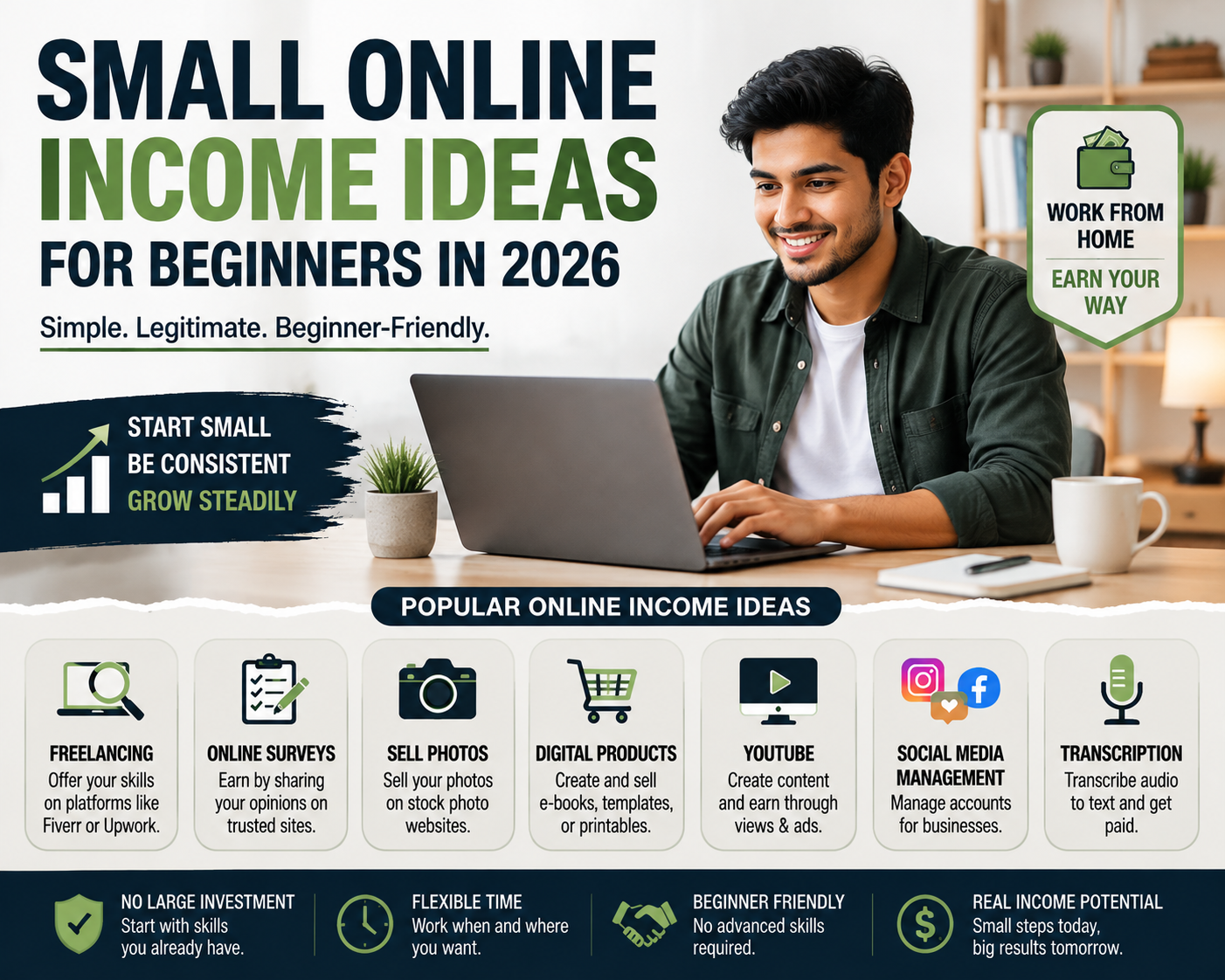
These are online income ideas from home that require no commute and, in most cases, no upfront investment. The goal isn’t to replace a full salary overnight. It’s to find one method that fits your actual schedule and build from there.
Avoid These Online Income Scams First
Before anything else beginners are the most common targets for online earning scams. Here’s what to watch out for:
1. Jobs that ask for an upfront fee
Any “job” that asks you to pay \$20, \$50, or \$100 before you can start working is a scam. Legitimate platforms like Fiverr, Rev, or UserTesting are always free to join.
2. Fake data entry jobs
These are everywhere. They usually promise \$300–\$500/week for simple typing work, then ask for a “starter kit” fee or steal your personal information. Real data entry work exists (on platforms like Upwork or Freelancer), but it pays much less usually \$5–\$15/hour.
3. “Earn \$500/day” promises
If a website promises \$500 a day for simple online work with no experience it’s not real. No legitimate platform pays that much for beginner-level tasks. Realistic beginner earnings are in the \$50–\$300/month range, not per day.
4. MLM (Multi-Level Marketing) programs
These aren’t exactly a job. They require you to recruit others to earn, and most participants don’t make a consistent income. According to a 2023 FTC study, the vast majority of MLM participants earn less than \$1,000/year.
5. Fake investment schemes
Any platform promising guaranteed investment returns for doing small tasks (like “rate products” to earn crypto) is almost always a scam. Legitimate investment involves real risk and is never tied to small online tasks.
Safe rule: Stick to platforms mentioned in this guide. They’re established, publicly known, and don’t ask for money upfront.
Full Comparison: Which Method Fits You?
Use this table to pick one method based on your actual situation time available, device, skills, and how soon you need income.
| Method | Difficulty | Learning Time | Time to First Earning | Income Type | Risk Level | Country Availability |
|---|---|---|---|---|---|---|
| User Testing | Easy | 1–2 hours | 1–3 days | Active | Very Low | US, UK, CA, AU (limited elsewhere) |
| Mobile Microtasks (Swagbucks) | Easy | 30 minutes | Same day | Active | Very Low | 100+ countries |
| Transcription (Rev/Scribie) | Easy–Medium | 1 week practice | 1–2 weeks | Active | Low | Global (PayPal required) |
| AI-Assisted Freelancing | Medium | 1–2 weeks | 1–3 weeks | Active | Low | Global |
| Micro-Freelancing (Fiverr) | Medium | 1–2 weeks | 2–4 weeks | Active | Low | Global |
| Digital Products (Gumroad/Etsy) | Medium | 1–3 weeks | 1–4 weeks | Semi-Passive | Low | Global |
| Social Media Management | Medium | 2–3 weeks | 2–6 weeks | Active | Low | Global |
| Selling Photos (Foap) | Easy | 1–2 hours | 1–4 weeks | Semi-Passive | Very Low | Global |
| Reselling (eBay/Facebook) | Easy–Medium | 1 week | 3–7 days | Active | Medium | US, UK, CA, AU (best markets) |
Note on earnings: Beginner monthly ranges vary widely based on time invested and consistency. Most methods realistically earn \$20–\$300/month in the first 1–3 months. Higher ranges are possible but depend on skill level, client volume, and time commitment.
AI-Assisted Earning Methods for Beginners
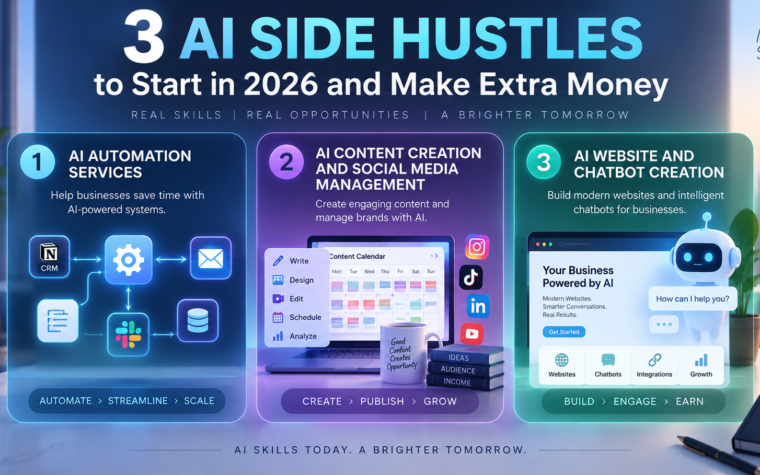
This is one of the more practical shifts that happened in 2024–2025. AI tools like ChatGPT, Gemini, and Claude have reduced the skills barrier for several types of online work. You don’t need to be a writer to deliver decent written content. You don’t need design experience to create clean graphics.
That said AI doesn’t do the work for you. It speeds up the process. The human judgment, editing, and quality control still need to come from you.
AI-Assisted Blog Writing
Businesses constantly need blog posts, product descriptions, and website copy. A beginner can use AI to produce a solid draft, then edit it for accuracy, tone, and usefulness before delivering it to a client.
Platforms like ProBlogger Job Board and Contena list content writing gigs starting at \$25–\$75 per article. Some beginners who combine AI drafting with careful human editing report earning in the range of \$100–\$400/month from content work alone though results depend heavily on consistency and how well you customize AI output.
Practical gig examples on Fiverr:
- “I will write a 500-word blog post for your website” (\$15–\$30)
- “I will write product descriptions for your Shopify store” (\$10–\$25 for 5 descriptions)
- “I will write email newsletters for your business” (\$20–\$50 per email)
AI-Generated Printables on Etsy
Tools like Canva (with AI features) and Adobe Express make it straightforward to design printable planners, worksheets, wall art, or budgeting templates. You upload these as digital downloads on Etsy no shipping, no inventory.
According to Etsy’s 2025 Seller Report, digital products are among the fastest-growing categories on the platform. A beginner shop with 10–15 listings can realistically generate steady semi-passive income once the listings are live and optimized.
Product ideas that sell:
- Weekly meal planners
- Student study schedule templates
- Wedding budget trackers
- Resume and cover letter templates
- Social media content calendars
AI Prompt Writing as a Service
Small business owners and marketers often struggle to get consistent, useful results from AI tools. If you’ve spent time learning how to write effective prompts for ChatGPT or Midjourney, that’s something you can sell. Fiverr now has a dedicated “AI Prompts” category with active buyers.
Free starter tools:
- ChatGPT openai.com
- Google Gemini gemini.google.com
- Canva AI canva.com
- Adobe Firefly irefly.adobe.com
Online Earning Methods Using Only a Phone
Not everyone has a laptop. Several online jobs for beginners with no experience work entirely from a smartphone.
Sell Stock Photos
Apps like Foap and Shutterstock Contributor let you upload photos taken on your phone. Individual photos sell for \$1–\$10 per download, and the same photo can sell multiple times.
Foap also runs “brand missions” companies post a specific photo brief and pay \$100–\$500 to the winner. Competition is high, but the time investment for a single submission is minimal.
Swagbucks and Survey Apps
Swagbucks (swagbucks.com) pays in “SB points” for surveys, short videos, and microtasks. 100 SB = \$1. Average earnings are roughly \$1–\$5/hour not life changing, but it’s one of the few online income ideas with no skills required that actually delivers real payouts.
Survey Junkie has paid out over \$55 million to users as of 2025 (source) and holds a 4.5/5 rating on Trustpilot. It’s available in the US, Canada, and Australia.
Branded Surveys is another decent option, especially if Survey Junkie runs out of surveys for your demographic.
Microtask Apps
Gigwalk and Field Agent pay \$3 \$12 per task for things like verifying business information, checking store shelf displays, or photographing product packaging. These are phone-only, require no portfolio, and are among the most accessible online jobs for beginners with no experience.
Micro-Freelancing on Fiverr or Contra
This is still one of the clearest paths for beginner online income ideas with no experience needed because you don’t need to build an audience or drive traffic. Fiverr has millions of buyers already looking for services.
The most in-demand beginner gigs in 2025–2026 have shifted toward:
- AI prompt writing
- Short video editing for Reels and TikTok
- Data cleanup and spreadsheet formatting
- Transcription
- Canva graphic design
Specific task examples beginners can offer:
- Remove backgrounds from product photos (\$5–\$15 per batch)
- Convert PDF files to editable Word documents (\$5–\$10 per file)
- Create Canva social media posts (\$10–\$25 for a set)
- Resize and format images for websites (\$5–\$15)
- Transcribe short audio files (\$10–\$20 per 10 minutes of audio)
- Write product descriptions for e-commerce stores (\$5–\$20 each)
What actually helps beginners get orders:
- Write a gig title that describes exactly what you do not vague phrases like “professional services”
- Deliver at least a few hours before your stated deadline this alone gets positive reviews
- After delivery, ask briefly whether everything met expectations satisfied buyers often leave reviews when nudged politely
Contra is worth checking too. It charges 0% commission, which means you keep every dollar a client pays you a meaningful difference when you’re starting out.
Selling Digital Products (Gumroad or Etsy)
You don’t need design skills to sell digital products. You need a specific idea for a specific audience.
The difference between a product that sits unsold and one that earns is specificity. “Workout guide” is too broad. “4-week bodyweight program for people recovering from a knee injury” finds a real audience with a real problem.
Practical product ideas by niche:
For students and teachers:
- IELTS vocabulary flashcard sets
- Lecture note templates in Notion or Google Docs
- Lesson planners for specific grade levels
For small business owners:
- Instagram content calendar templates
- Invoice and quote templates
- Client onboarding checklists
For personal finance:
- Monthly budget spreadsheet (Google Sheets)
- Debt payoff tracker
- Bill payment reminder template
Beginners who build 10–20 focused listings and actively share them in relevant online communities (Facebook groups, Reddit, Pinterest) report steadily growing semi-passive sales over 2–3 months. Results vary based on niche demand and how well listings are written.
This is one of the better simple side hustles from home for anyone who wants something that can run in the background with minimal ongoing effort.
Transcription Work (Rev, Scribie, Verbit)
If you type fast and have good listening focus, transcription is a low-friction way to build a beginner online income without investment.
Rev.com pays \$0.45–\$1.10 per audio minute. According to Rev’s own published rates, a practised transcriptionist completing 3–4 audio minutes per 15 real-time minutes would earn roughly \$9–\$18/hour. Beginners will be slower at first expect \$5–\$8/hour when starting.
Scribie pays \$0.10 per audio minute but has an easier approval process. A good starting point before attempting Rev.
Verbit is more advanced and typically requires experience, but pays higher rates for specialised audio (legal, medical, academic).
One practical warning: Rev rejects around 60–70% of first-time applicants based on published transcriptionist community data. Before applying, spend a week practising by transcribing YouTube content at 75% playback speed. It noticeably improves accuracy and speed.
User Testing (UserTesting, Maze, Respondent)
Companies pay real people to test their websites and apps before launching updates. You use the product, narrate what you’re doing and thinking, and record your screen for 10–20 minutes.
| Platform | Pay Per Session | Session Length | Payment Method | Payout Time |
|---|---|---|---|---|
| UserTesting.com | \$10 | 20 minutes | PayPal | 7 days after approval |
| Respondent.io | \$50–\$150/hr | 30–60 minutes | PayPal, Venmo | After study completion |
| Maze | \$5–\$25 | 10–15 minutes | PayPal | Varies |
The main limitation: not every test will match your demographic. Some weeks you’ll qualify for several; others you’ll qualify for none. Beginners who stay signed in and check the app regularly tend to catch more tests.
User testing requires no prior experience and no investment making it one of the most accessible online jobs for beginners with no experience.
Social Media Management for Local Businesses
Many small local businesses — salons, bakeries, gyms, dental offices — have social media accounts that go weeks without a post. They know it matters but don’t have the time.
If you can create basic graphics in Canva, write short captions, and post consistently on a schedule, you can offer this as a service.
What this actually involves day-to-day:
- Designing 3–4 posts per week using Canva templates
- Writing short captions (50–100 words, conversational tone)
- Scheduling posts using free tools like Buffer or Meta Business Suite
- Occasionally responding to comments or DMs
Beginners typically charge \$100–\$200/month per client for this. After getting comfortable, rates of \$250–\$400/month per client are reasonable.
A practical way to start: reach out to three local businesses you already use. Offer a two-week free trial. If their page looks noticeably better and engagement improves, most owners are willing to pay for it to continue.
How You Actually Get Paid
This section gets skipped in most guides. It matters especially if you’re outside the US.
| Platform | Payment Methods | Minimum Payout | Pay Schedule |
|---|---|---|---|
| Fiverr | PayPal, bank transfer, Payoneer | \$5 | 14 days after order completes |
| Contra | PayPal, Stripe, US bank | \$1 | On request |
| Gumroad | PayPal, bank transfer | \$10 | Weekly (Fridays) |
| Etsy | PayPal, bank transfer | Varies by country | Weekly or monthly |
| Rev.com | PayPal | \$50 | Weekly (Mondays) |
| Scribie | PayPal | \$1 | On request |
| UserTesting | PayPal | \$10 | 7 days after test approval |
| Respondent.io | PayPal, Venmo | \$20 | After study completion |
| Swagbucks | PayPal, gift cards | \$3 (gift cards) / \$25 (PayPal) | On request |
| Survey Junkie | PayPal, bank transfer, gift cards | \$5 | On request |
PayPal is accepted by almost every platform here. A free PayPal account takes about 10 minutes to set up at paypal.com.
If PayPal isn’t available in your country, Payoneer (payoneer.com) is the most widely accepted alternative it works with Fiverr, Upwork, Amazon, and several survey platforms.
Country note: PayPal has restrictions in countries including Pakistan, Bangladesh, and parts of Africa. If you’re in one of these regions, set up Payoneer or Wise (wise.com) before you start not after your first earnings are waiting.
Which Method Should You Start With?
Under 1 hour/day available:
→ User Testing or Swagbucks. No learning curve, no portfolio needed.
Phone only, no laptop:
→ Foap for photography, Swagbucks for surveys, or Gigwalk for local microtasks.
1–2 hours/day with a laptop:
→ Scribie transcription to start (lower approval bar), then apply to Rev once comfortable.
2–3 hours/day, willing to learn one skill:
→ Micro-freelancing on Fiverr with AI assistance. Specific gigs (PDF conversion, background removal, Canva posts) require minimal setup.
Student with subject knowledge:
→ Sell a digital product on Gumroad. A well-formatted study guide, formula sheet, or exam checklist is a practical small online income idea for students — it earns steadily with zero ongoing effort after upload.
Want income that continues while you sleep:
→ Digital products on Etsy or Gumroad. Slower to set up, but the only truly semi-passive option here.
Want weekly payments with no client communication:
→ Rev.com (after passing the test) pays every Monday directly to PayPal.
Mistakes Beginners Usually Make
Trying multiple things at once. Nothing gains traction when attention is split. Picking one method and sticking with it for 30 days gives a much clearer picture of what’s working.
Undercharging permanently. Starting at lower rates to build reviews makes sense. But staying at minimum rates for months leaves real money uncollected. A practical rule: after 5 positive reviews on any platform, increase the rate by 20–30%.
Waiting until everything is “perfect” to launch. A rough digital product uploaded today earns more than a polished one sitting in drafts. The same goes for a Fiverr gig an imperfect listing live now will get more feedback and orders than one you’re still tweaking.
Ignoring negative feedback. Client criticism tends to feel personal. It’s more useful to treat it as information it often points directly to what needs to improve.
Choosing a method that doesn’t fit available time. If real daily availability is 20 30 minutes, survey apps or user testing fit better than building a freelance business, which needs longer focused sessions.
Frequently Asked Questions
Q: What is the easiest online income method for beginners?
A: User Testing requires no skills, no portfolio, and no upfront setup. You just sign up, complete a sample test, and wait for qualifying tests to appear. Swagbucks is similarly simple but pays less per hour.
Q: Can I start a beginner online income without any skills?
A: Yes, but the pay is lower. Survey apps, microtask platforms like Gigwalk, and user testing all accept people with zero relevant experience. For higher-paying options, learning even one basic skill (like Canva or fast typing) opens more doors.
Q: Which beginner online jobs pay weekly?
A: Rev.com pays every Monday via PayPal. Gumroad pays creators every Friday. Fiverr releases funds 14 days after order completion (so with regular orders, you’re receiving weekly payouts in rotation). UserTesting pays within 7 days of test approval.
Q: How much can beginners realistically earn in the first 3 months?
A: Based on Payoneer’s 2025 freelancer survey, most beginners earn \$50–\$300/month in their first 1–3 months. By month three with consistent effort on one method, \$200–\$500/month is achievable for many people. Higher amounts are possible but aren’t typical starting points.
Q: What is the safest online earning method?
A: The safest methods are established platforms that are free to join and transparent about pay rates Rev, UserTesting, Fiverr, Gumroad, and Swagbucks all qualify. The risk is minimal as long as you don’t share sensitive personal information beyond what account creation requires, and never pay a platform to access work.
Q: Can students earn online without any investment?
A: Yes. Most platforms on this list are free to join. Transcription, user testing, survey apps, and micro-freelancing all require no upfront money. The only exception is reselling, which needs a small amount to buy inventory.
Q: Do I need to live in the US to earn on these platforms?
A: Most platforms accept international users. Fiverr, Gumroad, Etsy, Scribie, and Swagbucks all work globally. UserTesting and Respondent have stronger availability in the US, UK, Canada, and Australia. Survey Junkie is primarily US, Canada, and Australia. Always check a platform’s country list before spending time setting up an account.
Q: How long before I earn my first dollar online?
A: UserTesting and microtask apps can pay out within 2–3 days of signing up. Fiverr and Gumroad typically take 2–4 weeks before the first sale or order comes in. Transcription can take 1–2 weeks if you pass the Rev test on your first attempt.
Q: Is it possible to earn from home online without showing my face?
A: Yes. Transcription, digital products, data freelancing, spreadsheet gigs, and survey apps all work without video, social media presence, or any personal branding.
What to Do First
- Look at the comparison table and pick one method based on your device and daily availability
- Create an account on that single platform only avoid opening five at once
- Spend the first week learning how the platform works before expecting any income
- Set a small, concrete 30-day goal: “complete 5 user tests” or “upload one Gumroad product”
- Track time spent versus what you actually earn this tells you quickly what’s worth continuing
Final Thought
The pattern that shows up consistently among beginners who actually build small online income is simple: they pick one method, stay with it longer than feels comfortable, and gradually get better at it.
It’s less about finding the “right” method and more about sticking with one long enough to understand it. Most people give up two weeks before they would have seen results.
Pick one thing from this list. Give it 30 real days. That’s a better use of time than reading another dozen guides.
Sources & References
- Payoneer Global Freelancer Income Report 2025
- Etsy 2025 Seller Statistics — Investor Relations
- Survey Junkie — About & Payout Info
- Rev.com — Transcriptionist Pay Rates
- UserTesting — How It Works for Testers
- Statista: Gig Economy Size & Growth 2020–2026
- Gumroad Creator Help Center
- FTC Report on Multi-Level Marketing Income Disclosure (2023)
This article does not guarantee any level of income. Earnings depend on time invested, platform availability in your region, and consistency. Platform pay rates and terms are subject to change verify directly with each platform before committing.
How I Started Making Real Money Online And What I Wish Someone Had Told Me First
I still remember staring at my laptop at 1 a.m., three months into my first real job, feeling completely burned out and underpaid. A friend had casually mentioned he was making an “extra $800 a month” doing stuff online. I thought he was either lying or running some kind of scam.
He wasn’t.
That night started a pretty wild two-year journey of trial, error, embarrassing failures, and eventually real, consistent income from the internet. And honestly? The hardest part wasn’t the money. It was cutting through all the noise to figure out what actually works.
So let me save you the two years.
First, Let’s Get One Thing Straight
Making money online is real. But it’s not magic, and it’s definitely not passive in the beginning no matter what that guy in a rented Ferrari on YouTube is telling you.
Most people fail at this not because they’re not smart enough. They fail because they’re chasing shortcuts, picking the wrong method for their actual situation, or giving up in week three when nothing has paid out yet.
The methods I’m about to walk you through are things I’ve either done myself or have seen work for people I know personally. No theory. No “just start a blog and profit.”
1. Freelancing: The Fastest Way to Your First Dollar Online
If you have any skill writing, design, coding, video editing, social media management, even data entry freelancing is hands-down the fastest way to start earning online.
I started on Upwork with a half-baked profile and zero reviews. My first two proposals were completely ignored. But my third one landed a $120 project for writing three product descriptions. Not glamorous. But it was real money from real work, and it hit my account within a week.
The platforms worth your time:
- Upwork Best for long term clients and higher-paying contracts. Competitive, but worth it.
- Fiverr Great for packaging a specific service into a “gig.” Works especially well for creative work.
- Toptal If you’re a developer or designer with serious chops, this is where the high rates are.
- PeoplePerHour Underrated. Less competition than Upwork in a lot of categories.
What actually works on these platforms: A specific offer beats a generic one every time. “I’m a writer” gets ignored. “I write email sequences for SaaS companies that increase trial-to-paid conversions” gets hired.
The mistake I made early on? Setting my rates embarrassingly low thinking it would get me more jobs. It mostly just attracted bad clients who still complained. Charge what a reasonable skilled person would charge, and you’ll get better clients who respect your time.
2. Content Creation: Slower, But It Compounds
YouTube, blogging, and newsletters are the “slow burn” options. You won’t make money in month one. Maybe not even month six. But the people who stick with it often end up with income that runs whether or not they’re sitting at their desk.
A friend of mine started a YouTube channel about budget cooking. Nothing fancy just his phone on a stand and a ring light he bought for $30 on Amazon. Two years in, he’s pulling around $2,400/month from AdSense alone, with some sponsorships stacked on top.
What he did right:
- He picked a topic he could talk about for two hours without getting bored
- He stayed consistent one video per week, no matter what
- He learned basic SEO so his videos could actually be found
For blogging, WordPress with a decent theme is still the move. For newsletters, Beehiiv and Substack have both made it way easier to monetize a writing audience without needing to be a tech person.
The honest truth about content creation: most people quit too early. The algorithm rewards consistency and time in the game. If you’re not willing to create content for six months without significant financial return, this path probably isn’t for you right now.
3. Affiliate Marketing: Earning While You Sleep (Eventually)
Affiliate marketing is when you recommend someone else’s product and earn a commission when someone buys through your link. No product to create. No customer service. Just you pointing people toward stuff that genuinely helps them.
I made my first affiliate commission $47 from a review post I wrote about a project management tool I was actually using. That post took me about three hours to write. It’s still making small amounts of money years later.
Good places to find affiliate programs:
- Amazon Associates Low commissions (1-4%), but literally almost any product you can link
- ShareASale and CJ Affiliate Networks with tons of brands across different niches
- Individual company programs Many SaaS tools like Notion, ConvertKit, Shopify, and others have their own affiliate programs that pay significantly more
The key thing most affiliate “gurus” skip over: you need an audience first. Whether that’s a blog with search traffic, a YouTube channel, a newsletter, or even a niche Instagram page you need somewhere people are already showing up to trust your recommendations.
Throwing affiliate links into content nobody reads is just wasted effort.
4. Selling Digital Products: One Time Work, Recurring Revenue
This is one I wish I’d started earlier. Digital products things like templates, ebooks, online courses, presets, planners, stock photos can be created once and sold forever.
I put together a simple Notion dashboard template last year. Spent maybe six hours on it. Listed it on Gumroad for $9. It’s made just over $1,100 to date without me doing anything after the initial marketing push.
The easiest wins I’ve seen in this space:
- Canva templates Designers sell these for $5-$30 a pop on platforms like Creative Market and Etsy
- Resume or LinkedIn templates Huge demand, simple to make if you know basic design
- Mini-courses and workshops Platforms like Teachable, Thinkific, or Podia make hosting easy
- Photography presets If you’re into photography, these sell consistently on Etsy and your own site
The barrier is usually psychological, not practical. People overthink whether their product is “good enough.” A $12 Notion template doesn’t need to be perfect. It just needs to save someone an hour.
5. Online Tutoring and Coaching: If You Know Something, Teach It
You don’t need a teaching degree or a certification to help people learn things online.
Platforms like Preply, Wyzant, and Tutor.com connect tutors with students in almost every subject. If you’re fluent in English and want to teach it as a foreign language, iTalki and Cambly are popular and beginner-friendly.
Beyond formal tutoring, skills coaching has exploded. Career coaches, fitness coaches, financial coaches there’s a huge market for people who want personalized guidance rather than just another course.
I know someone who was a marketing manager, started offering 1 on 1 strategy sessions on weekends through a simple Calendly booking page and Stripe for payments. No fancy website. Just DMs and word of mouth. Now she earns more from those two weekend hours than she does in two days at her regular job.
Common Mistakes That Will Slow You Down
Let me be real about the stuff that tripped me up:
Jumping between methods too fast. Every week there’s a new “best” way to make money online. The people chasing every trend rarely build anything. Pick one method and commit for at least three months before evaluating.
Treating it like a lottery. The “post once and make $10k” fantasy is marketing designed to sell you a course. Real online income is built slowly, through consistent work and gradual improvement.
Skipping the learning phase. I wasted time thinking I could just “figure it out.” Taking two weeks to seriously learn the basics of whatever you’re doing saves months of spinning your wheels. YouTube has free tutorials for literally everything.
Ignoring taxes. This one bites a lot of new online earners. If you’re making money freelancing or selling products, you’re technically self-employed in most countries. Set aside a percentage of every payment for tax season. I learned this the hard way.
Expecting overnight results. The mental model that actually helped me: think of the first three months as tuition. You’re learning, building, and investing in your future earning potential.
So Where Do You Actually Start?
If you’re completely new to this, here’s a simple decision framework:
- Need money quickly? Start with freelancing. Audit your skills, build a profile on Upwork or Fiverr, and send out proposals this week.
- Have patience and like creating things? Start a YouTube channel or blog around something you genuinely know or care about.
- Have specialized knowledge? Consider tutoring or coaching while you build something larger on the side.
- Like the idea of passive income? Create one small digital product and sell it through Gumroad. Keep it simple. Test what resonates.
The worst thing you can do is spend another six months reading about making money online without actually trying something. Even a stumbling attempt teaches you more than a hundred YouTube videos.
One Last Thing
Nobody I know who earns consistently online did it in a straight line. There were failed niches, zero view videos, proposals that went nowhere, and products that flopped. That’s normal. It’s not a sign you should quit it’s just the actual learning process.
The people who figure this out aren’t especially talented. They’re just the ones who kept going a little longer than everyone else.
Start somewhere. Stay consistent. Adjust as you go.
The internet isn’t going anywhere, and neither is the opportunity to build something real on it.

Muqit is an author at Insiders Desk, creating simple and practical guides to online business and digital income. He writes about business models, digital tools, SEO, content creation, and monetization methods, with a focus on clear explanations, realistic expectations, and informed decision-making. His content is educational and does not promise guaranteed income or business results.