
You’re Skinny — So Why Is There Still a Belly?
Kamran Siddiqui•May 2026•7 min read
My cousin weighs 58 kg soaking wet. He can eat two plates of biryani, skip the gym for six months, and still not gain a single kilo on his arms or legs. But his belly? That thing has been sitting there since he turned 30 round, firm, and completely unbothered by anything he does or doesn’t do.
For the longest time, I assumed belly fat was something that only happened to people who were generally overweight. I thought if you were lean everywhere else, the belly would follow. But after watching my cousin struggle with this and honestly dealing with a bit of it myself after my early 30s hit I started digging deeper. What I found genuinely surprised me, and I think it’ll surprise a lot of people who are in the same situation.
There’s a Name for This, and It’s More Common Than You Think
Researchers actually have a term for people who are thin on the outside but carrying significant internal fat: TOFI, which stands for Thin Outside, Fat Inside. It sounds almost comical, but it’s a real and well documented phenomenon that affects a surprisingly large number of people who look perfectly healthy by conventional standards.
The problem with how most of us measure health is that we rely on weight and BMI and BMI is, frankly, a pretty crude tool. It tells you your weight relative to your height, and that’s about it. It tells you nothing about where your fat is distributed or what it’s doing to your body internally. You can have a completely normal BMI and still have dangerous amounts of fat wrapped around your liver, intestines, and other vital organs. That’s called visceral fat, and it’s the kind you need to actually worry about.
There’s an important difference between the two main types of body fat. Subcutaneous fat is the soft, pinchable stuff just under your skin it’s what most people think of when they think of body fat. Visceral fat is deeper, sitting behind your abdominal muscles and surrounding your organs. On a thin person, the belly you can see is often visceral fat pushing outward, and unlike subcutaneous fat, it’s metabolically active in ways that can genuinely harm your health over time driving inflammation, affecting insulin sensitivity, and raising the risk of heart disease and type 2 diabetes.
“Some thin people have metabolic profiles closer to obese individuals than to their lean peers not because of how they look, but because of what’s happening inside.”
Why Does This Happen to Thin People?
Genetics play a bigger role here than most people want to admit. Some people are simply wired to store excess energy viscerally rather than subcutaneously. South Asian and East Asian populations, for example, tend to accumulate visceral fat at lower overall body weights compared to Western populations it’s not a lifestyle failure, it’s a biological predisposition. If your parents or grandparents carried weight around their middle despite being otherwise thin, your body likely has a similar tendency baked in.
Beyond genetics, one of the most underappreciated causes is the combination of low muscle mass and a sedentary lifestyle. There’s a big difference between being thin and being lean. A truly lean person has a good amount of muscle relative to their body weight. Many thin people, however, are light because they have barely any muscle not because they’re metabolically healthy. When muscle mass is low, your resting metabolism is sluggish, and your body doesn’t have productive places to put incoming energy. So it defaults to visceral storage, especially around the abdomen. My cousin hasn’t done any meaningful exercise in years. He’s light on the scale, but he’s carrying almost no muscle.
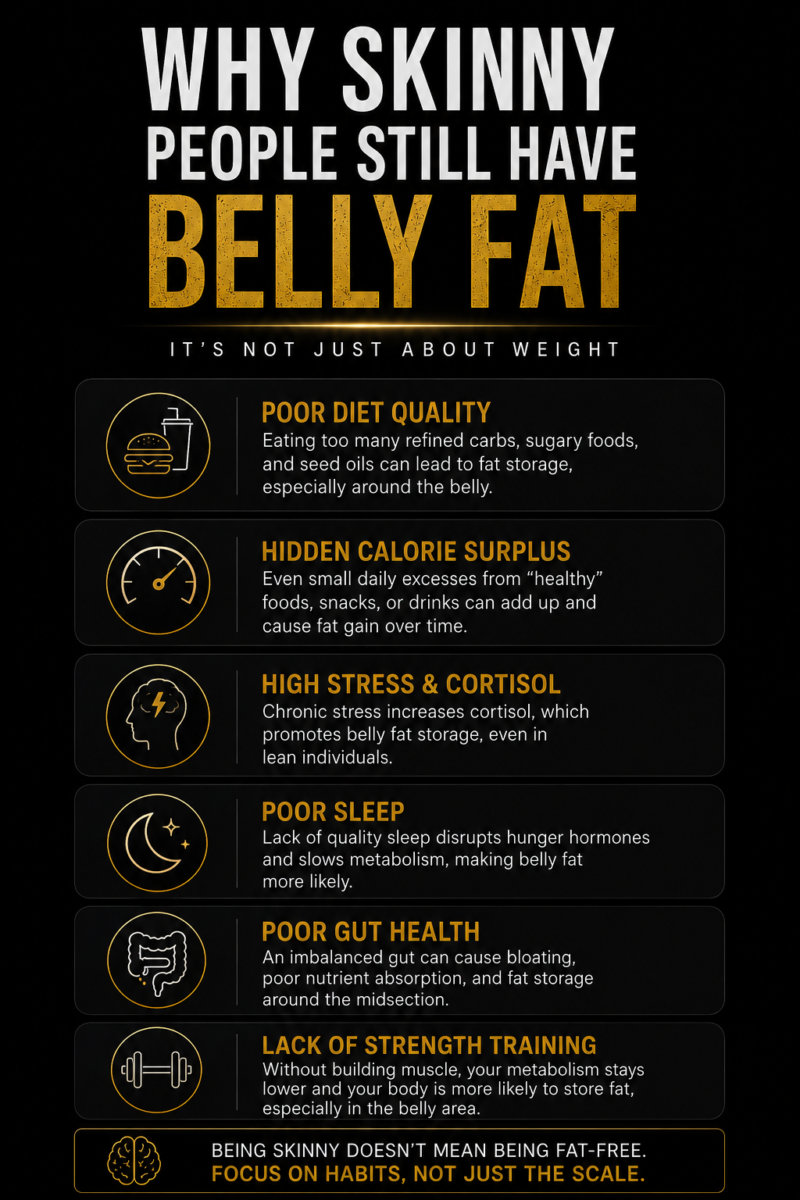
Then there’s the cortisol connection, which genuinely blew my mind when I first came across it. Cortisol is your primary stress hormone, and it has a direct relationship with visceral fat accumulation. When your body is under chronic stress whether from work pressure, poor sleep, anxiety, or even too much caffeine cortisol stays elevated, and your body responds by hoarding fuel near your core where it can be mobilized quickly in an emergency. The problem is, most modern stress isn’t the kind you can run away from, so the fat just stays there. I noticed this firsthand during a particularly brutal work stretch I was sleeping badly, stressed constantly, and my waist measurement crept up even though my overall weight barely changed. I was losing muscle and gaining visceral fat at the same time, and the scale was completely oblivious to it.
Diet quality is another factor that often gets missed in conversations about thin people. Being slim doesn’t mean your metabolism is handling food well it just means your energy balance works out. A thin person who regularly eats refined carbohydrates, sugary drinks, or heavily processed food is giving their liver more glucose than it can deal with, and the liver converts that excess into fat. And that fat tends to land viscerally. Alcohol is particularly notorious for this even moderate, regular drinking has a well established link to visceral fat accumulation specifically. Many thin people drink casually and consistently without realizing it’s actively building their belly.
Age compounds everything. As testosterone declines in men and estrogen declines in women through the 30s and 40s, the body’s fat distribution shifts away from the limbs and toward the abdomen. It’s one of the most consistent findings in aging research. This is why so many people notice the belly appearing or worsening in midlife even when their habits haven’t dramatically changed. The hormonal environment has shifted, and the body is responding accordingly.
Worth knowing: Around 30% of normal-weight adults are estimated to have metabolic obesity where their internal fat and blood markers look more like someone who is obese, despite their outward appearance. Blood tests often reveal this when nothing else does.
How to Actually Know What You’re Dealing With
Before trying to fix anything, it’s worth getting an honest picture of what’s actually going on. The simplest starting point is your waist circumference, measured at the navel while relaxed no sucking in. A measurement above 90 cm for men or 80 cm for women is a red flag regardless of overall weight, and it’s one of the better predictors of visceral fat risk that doesn’t require any special equipment. What’s on the scale matters much less than what’s happening around your middle.
If you want more detail, a DEXA scan is the gold standard for body composition it breaks down exactly how much of your body weight is muscle, fat, and bone, and gives you a regional breakdown of where the fat is sitting. These are available at many hospitals and some gyms, and the information is genuinely eye opening. For at-home tracking, a bioelectrical impedance scale like the Withings Body+ or the RENPHO smart scale isn’t as precise as a DEXA, but it gives you a useful trend over weeks and months. I use a Withings scale at home, and while I don’t obsess over the daily numbers, the long term trend has been genuinely informative.
Blood work is probably the most important piece of the puzzle that most people skip. Asking your doctor for fasting insulin levels, triglycerides, HbA1c, and a basic lipid panel tells you far more about your actual metabolic health than any visual assessment. These markers reveal what your visceral fat is actively doing to your physiology. My cousin’s high triglycerides flagged during a routine checkup were the first real signal that something needed to change, even though he looked completely normal from the outside.
What Actually Makes a Difference
Strength training is the single most impactful intervention for this specific problem, and it’s the one that thin people most often skip because they assume they don’t need to build muscle. But building muscle is exactly the point it changes your metabolic baseline, gives your body a productive destination for glucose, and gradually shifts your body composition even if your total weight barely moves. Two or three sessions a week of basic resistance work, done consistently over three to four months, makes a measurable difference. You don’t need to become a bodybuilder. You just need to stop being functionally sedentary.
Reducing refined carbohydrates and alcohol doesn’t mean going on a restrictive diet it means being honest about what’s consistently driving visceral fat. Swapping some white rice or bread for whole food sources and cutting alcohol from a regular habit to an occasional one are two changes that have a disproportionately large impact on belly fat specifically. Research on visceral fat reduction consistently points to alcohol reduction as one of the faster acting dietary changes, often showing measurable results within weeks of cutting back meaningfully.
Sleep is something most health advice mentions briefly and then moves on from, but it deserves more weight than that. Sleeping under six hours a night chronically elevates cortisol, disrupts ghrelin and leptin the hormones that regulate hunger and satiety and directly promotes visceral fat storage. No diet or exercise program works at full effectiveness on top of chronic sleep deprivation. Tracking your sleep with something like a Garmin, an Apple Watch, or even the free Sleep Cycle app can help you understand your actual patterns and identify what’s disrupting them.
Daily movement outside the gym is something that most people badly underestimate. Someone who sits for nine hours, drives to the gym, works out for an hour, and then sits again for the evening is still quite sedentary in terms of overall metabolic health. Research has repeatedly shown that people who move consistently throughout the day aiming for something like 8,000 to 10,000 steps accumulated gradually have meaningfully lower visceral fat than those who exercise intensely but are otherwise stationary. Walking is boring advice, but it’s boring because it works reliably.
Managing stress as a genuine health priority not just a nice to have rounds out the approach. This might mean therapy, clearer work boundaries, reducing caffeine, or simply building real downtime into your week. I started doing short breathing sessions using the Oak app, nothing dramatic, just a few minutes a few times a day to get my nervous system out of fight or flight mode. It feels almost too simple to matter, but over months it genuinely does. Your cortisol levels respond to consistent signals, and giving your body regular recovery time is one of those signals.
Mistakes That Keep People Stuck
The most common mistake is doing endless crunches and core exercises hoping to target the belly directly. Spot reduction doesn’t work it’s one of the most persistent fitness myths around. Abdominal exercises strengthen the muscles underneath, but the fat sitting on top only reduces when your overall body composition shifts. Someone doing 200 crunches a day while remaining otherwise sedentary and eating poorly will see almost no visible change in their belly.
Undereating is another trap that’s easy for thin people to fall into when they decide they want to tackle the belly. Eating too little chronically raises cortisol and puts the body into a conservation mode where it holds onto visceral fat while breaking down muscle. This is actually how the “skinny fat” situation often gets worse someone cuts calories aggressively, loses a bit of weight, but loses it from muscle rather than visceral fat, ending up with a worse body composition than before. Eating enough protein while being in a modest deficit, combined with strength training, is far more effective than just eating less.
Assuming you’re healthy because you’re slim is probably the most consequential mistake of all. Some of the worst metabolic blood panels belong to people who look perfectly fine. Getting actual blood work done isn’t just for people who are overweight for thin people with belly fat, it’s genuinely the only way to know what’s actually happening internally. And catching elevated triglycerides or insulin resistance early makes addressing it dramatically easier.
What Happened With My Cousin
After his doctor flagged high triglycerides at a routine check, my cousin finally got a DEXA scan done. His body fat percentage came back at 28%. For a man his age, that’s classified as obese even though he weighs 58 kg. He had almost no muscle mass and a significant concentration of visceral fat around his abdomen. The scale had been lying to him for years by telling him he was fine.
He made three changes: he started walking daily and accumulated about 8,000 steps, he added two gym sessions a week focused on basic resistance training, and he cut out the nightly beer he’d been drinking casually for years. Four months later, his waist dropped 6 cm, his triglycerides normalized, and he said he felt noticeably sharper mentally which makes sense, because visceral fat is linked to cognitive performance too. The belly hasn’t completely gone. But it’s visibly and measurably smaller, and more importantly, his actual health is moving in the right direction. He didn’t need to lose weight. He needed to change what that weight was made of.
If you’re lean everywhere but still carrying that stubborn middle, you’re not imagining it and you’re definitely not alone. Your body is doing something specific for specific reasons reasons that can be understood and genuinely changed with the right approach. The scale has never been the whole story. For a lot of people, it’s barely even a footnote.
https://insidersdesk.com/walking-vs-gym-which-one-actually-burns-fat-faster/

Minhas is the founder and editor of InsidersDesk, a health and wellness platform dedicated to providing practical, easy-to-understand information on fitness, nutrition, healthy living, and mental well-being. He researches trusted sources and transforms complex health topics into actionable advice that readers can apply in their daily lives. His goal is to help individuals build healthier habits and make informed decisions about their overall wellness.
1 response