
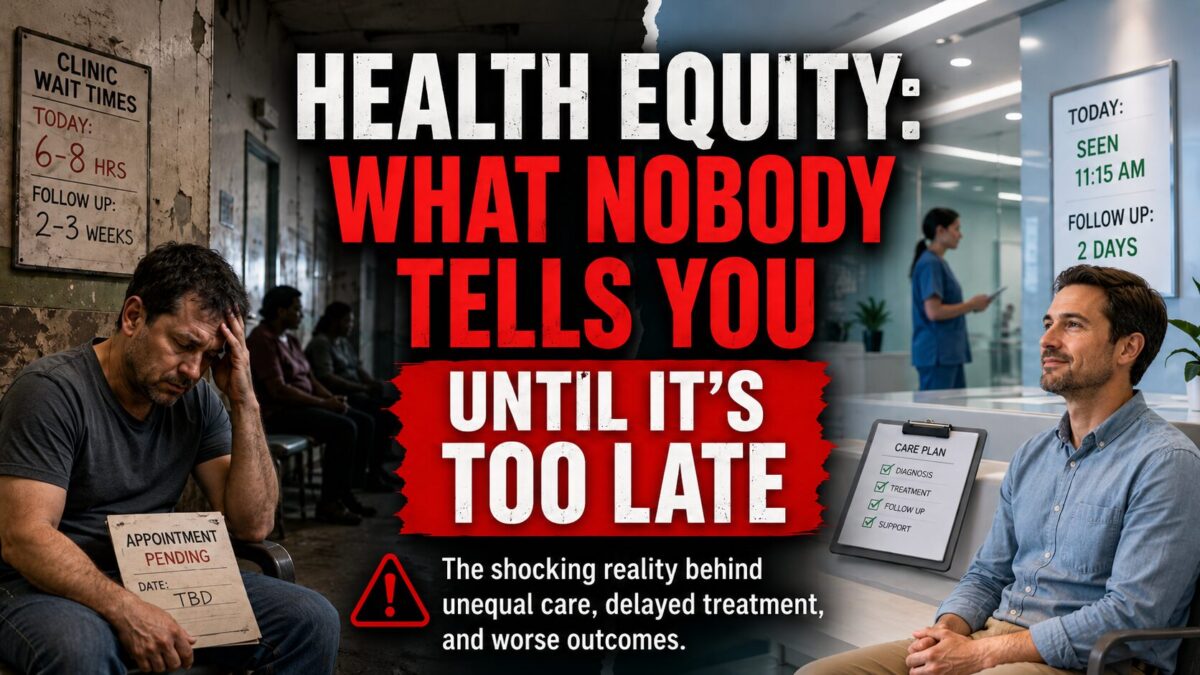
A few years ago, my uncle a man who had worked construction his whole life and never missed a day of work was diagnosed with Type 2 diabetes. The doctor handed him a brochure, told him to “eat better,” and sent him home. No dietitian. No follow-up call. No one to explain what “low glycemic index” even meant. He lived 45 minutes from the nearest clinic and didn’t own a car. That was the day I first really understood what health equity means. Not as a buzzword. As something that happens or doesn’t happen to real people.
If you’re reading this because you’ve seen or heard the phrase “health equity” thrown around and want to actually understand what it means and more importantly, what you can do about it you’re in the right place. This isn’t a lecture. It’s more like a conversation I wish I’d had years ago.
So What Is Health Equity, Really?
Health equity is the idea that every person, regardless of their zip code, income, race, gender, or education level, should have a fair shot at being healthy. Not equal fair. There’s an important difference there. Think of it this way: if two people are trying to see a concert, giving them both the same height stepstool doesn’t help if one of them is significantly shorter. Health equity means adjusting the stool to fit the need not handing everyone the same one and calling it done.
The opposite of health equity is a health disparity a preventable difference in health outcomes between groups. And these disparities are everywhere once you start looking. Rural communities with no specialists. Neighborhoods with no grocery stores but three fast food chains per block. Families where a single doctor visit means choosing between that appointment and this month’s rent. These aren’t edge cases. They’re the everyday reality for tens of millions of people.
The Stuff That Actually Affects Your Health That Has Nothing to Do With Medicine
Here’s what genuinely surprised me when I first started paying attention to this topic: roughly 80% of what determines your overall health has nothing to do with doctors, hospitals, or medications. It’s the conditions surrounding your daily life what researchers call the social determinants of health. Things like where you live, what you eat, whether you have stable housing, how much stress you carry, and whether the air in your neighborhood is clean or thick with industrial exhaust.
Studies have found a life expectancy gap of up to 15 years between wealthy zip codes and low-income ones in the same city. Fifteen year not because of genetics, and not because of individual choices but because of where a person was born and what resources were available to them growing up. That’s not a healthcare problem. That’s a society problem dressed up as one. And unless we start talking about it that way, the solutions we reach for will always be too small.
A Real Story: What Barriers Look Like Day to Day
Let me paint a picture. Say you’re a single mom working two part-time jobs, which means no employer health insurance. You notice a lump. You’re worried, but you can’t afford to take a weekday off without losing income. The clinic runs 9to5, the same hours you work. The nearest Federally Qualified Health Center which charges on a sliding-scale fee is across town, and your car broke down last month. By the time you figure out transportation, fill out the paperwork, and actually sit in front of a doctor, several months have passed. What could have been caught early is now more serious, more expensive, and harder to treat. This isn’t a hypothetical. This is Tuesday for millions of people.
My uncle’s story ended better than most, and here’s why: a community health worker funded through a small local grant started making house visits in his neighborhood. She spoke Urdu, which meant he could ask real questions without embarrassment. She brought him a glucose monitor, taught him how to use it, and connected him to a free diabetes education class held on Saturday mornings. Within a year, his A1C was back within range. Not because medicine changed. Because someone met him exactly where he was.
What’s Actually Being Done and What You Can Use
The good news is there are real tools, programs, and platforms making a genuine dent in health equity. The frustrating part is that most people who need them never hear about them. Telehealth apps like Teladoc, MDLive, and Amazon Clinic have made it dramatically easier for people to see a doctor without leaving home. For someone without reliable transportation, that shift is life-changing. But there’s a catch you need decent internet to use them. In rural areas, where health disparities are often the worst, broadband access is still unreliable or unaffordable. So telehealth solves one problem and runs straight into another. If you’re in a rural or underserved area, look specifically for your state’s telehealth programs through Medicaid expansions, which often have lower requirements and dedicated support lines.
Community health workers often called CHWs are one of the most powerful and least discussed tools in health equity work. These are trained individuals who act as a bridge between communities and the broader health system. They’re not doctors. They’re frequently members of the same community they serve, meaning they speak the language, understand the cultural context, and know which barriers are real versus which ones look like excuses to someone sitting in an office building. If your county has a health department, it’s worth calling them directly to ask whether a CHW program exists in your area. Many do, and they cost nothing to access.
For prescription costs specifically, GoodRx has become something of an equalizer. I’ve watched a medication that costs $140 at a standard pharmacy drop to under $22 with a GoodRx coupon. It doesn’t work for everything, but for common medications blood pressure drugs, metformin, mental health prescriptions the savings can be dramatic. It takes about 30 seconds to look up, and it requires no insurance at all.
How to Navigate a System That Wasn’t Built for You
The first thing to know is that you likely qualify for more help than you think. Medicaid eligibility expanded significantly after 2020, and the income thresholds are higher than most people realize. Healthcare.gov has a free screener that takes about five minutes to complete. Many people who believe they earn “too much” for assistance are genuinely surprised by the results.
If you’re dealing with a hospital or clinic visit, ask specifically for a patient navigator. Hospitals are required to have them, and their entire job is to help you understand your options, apply for financial assistance programs, and figure out how to get the care you need without drowning in paperwork. Most people have no idea this role exists. Patient navigators and social workers in clinical settings are often the difference between a person getting appropriate care and a person giving up halfway through the process.
When it comes to mental health, the gaps in equity are just as serious as in physical health and often more hidden. Black and Latino communities, for instance, face significantly higher rates of untreated depression and anxiety, frequently because of a combination of cultural stigma, distrust of medical institutions, and a shortage of therapists who share or deeply understand the patient’s background. Platforms like Inclusive Therapists and Therapy for Black Girls have built directories specifically designed to connect people with culturally responsive providers. Open Path Collective offers therapy sessions for $30 to $80 for people who can’t afford standard rates, which typically run $150 or more per hour.
When Well-Meaning Technology Makes Things Worse
One thing I didn’t expect when I started paying closer attention to this space: a lot of well-intentioned health technology accidentally deepens inequity rather than closing it. Many apps assume users have a smartphone and reliable data. Health portals are often only available in English. AI-powered diagnostic tools were frequently trained on datasets that skewed heavily toward white men, which means they perform worse on populations that weren’t well-represented in the training data.
There is actual published research showing that pulse oximeters the small finger clips that measure blood oxygen levels produce less accurate readings on darker skin tones. This wasn’t widely known until the COVID-19 pandemic, when it became a life-or-death issue for patients in hospitals across the country. It’s a stark reminder that the bias embedded in health equity isn’t always loud or obvious. Sometimes it’s built into the hardware, quietly producing worse outcomes for the people who are already most vulnerable.
The lesson is to ask questions. Who was this tool designed for? Has it been tested on people who share my background? When your care involves health technology, you have every right to ask your provider what that tool is, how it works, and how accurate it’s been shown to be for people like you. Advocating for yourself in that moment isn’t being difficult it’s being informed.
Common Mistakes That Make Things Harder
One of the most common mistakes people make is assuming they don’t qualify for any help. The assumption tends to be that assistance programs are only for people in extreme poverty, and anything above rock-bottom disqualifies you. In reality, most programs have income thresholds that cover a much broader range of people. The only way to know is to check and the five minutes it takes to do that can unlock meaningful support.
Another pattern I see often is waiting until a health issue becomes serious before seeking care. This is completely understandable visits cost money, time is scarce, and the system can feel hostile. But health disparities compound exactly this way: skipped screenings become late-stage diagnoses. A dental issue that would’ve cost $80 two years ago is now a $2,000 emergency. Preventive care, when it’s accessible, is always cheaper than crisis care. Finding a sliding-scale clinic and getting a baseline checkup even once a year can change the entire trajectory of someone’s health.
The third mistake, especially for women and people of color, is not pushing back when something feels wrong. Research consistently shows that these groups are more likely to be dismissed, undertreated, or have their symptoms attributed to stress or anxiety when something more serious is happening. If your doctor’s explanation doesn’t sit right with you, you are allowed to ask for more detail, request a referral, or seek a second opinion. That’s not being a difficult patient. That’s advocating for yourself in a system that doesn’t always do it for you.
What You Can Do Beyond Your Own Health
Health equity is a systemic problem, which means no single person can fix it alone. But that doesn’t make individual action meaningless. Volunteering with local organizations doing community health outreach food banks, free clinics, mental health programs moves real resources to the people who need them. Supporting local businesses that provide health insurance to workers, even when it would be cheaper not to, sets a standard that others can be held to. Voting in local elections and for health board positions matters enormously, because a huge portion of public health funding flows through local government, not Washington.
And sometimes the most powerful thing you can do is just talk about it. A lot of people have never heard the term “social determinants of health” and have no idea that a sliding-scale clinic exists four miles from their house. Information moves through communities person to person, especially in places the formal system doesn’t reach well. Telling a neighbor, sharing a post about a free health fair, or mentioning GoodRx to a friend who’s skipping a prescription because of cost none of that is nothing. That’s how things actually change.
My uncle still checks his glucose every morning. He’s doing well. But it took a community health worker, a small grant, a Saturday morning class, and a glucose monitor that someone physically brought to his door. It shouldn’t have been that complicated. And for most people, nobody shows up at the door.
Health equity isn’t about building a perfect system where no one ever struggles. It’s about closing the gaps we’ve decided consciously or not to leave open. It starts with recognizing they exist. And then it starts with all of us, doing whatever small thing we can manage, in whatever space we actually occupy.
Medical disclaimer:
This article is for educational purposes only and is not medical advice. Always consult a qualified healthcare professional.

Minhas is the founder and editor of InsidersDesk, a health and wellness platform dedicated to providing practical, easy-to-understand information on fitness, nutrition, healthy living, and mental well-being. He researches trusted sources and transforms complex health topics into actionable advice that readers can apply in their daily lives. His goal is to help individuals build healthier habits and make informed decisions about their overall wellness.