I ran two different faceless channels over the past four years. The first was a software tutorial channel focused on productivity tools. I could draft a script, record my screen, narrate the lesson, edit the footage, and publish within a single afternoon. That channel gained steady traction because the production schedule fit neatly alongside my daily routine.
The second project was a business documentary channel. Each video demanded fifteen to twenty hours of historical research, script revisions, and archival footage sourcing. I could not sustain that pace next to a full-time job. Uploads became irregular, audience momentum stalled, and I eventually paused the channel.The platform did not reject the topic; my production workflow simply collapsed under its own weight. That experience taught me that your content model and weekly production capacity matter far more than picking whatever topic looks popular on social media.
What Faceless Content Actually Means
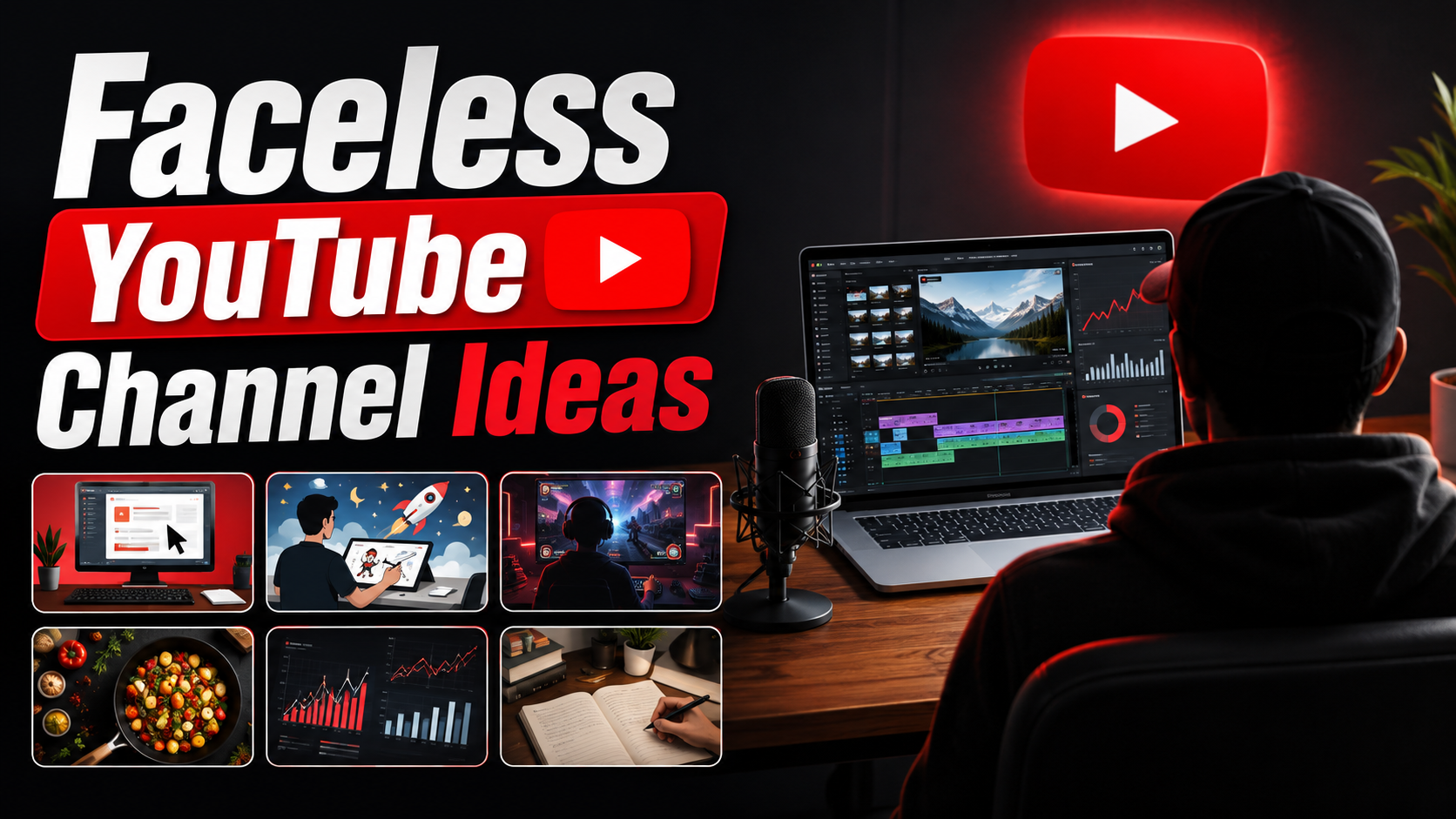
Many beginners assume that running a faceless channel means operating as a faceless, automated bot. In practice, a faceless channel simply means the creator does not appear physically in front of the camera. You can narrate over screencasts, record hands-only demonstrations, design custom animations, or build ambient audio environments.
Channels like Kurzgesagt, Lofi Girl, and Primitive Technology have built massive, loyal audiences without relying on a traditional talking-head presenter. YouTube’s recommendation system evaluates whether your videos hold attention and provide genuine value to viewers. The algorithm does not penalize you for staying behind the camera; it responds to audience satisfaction and creative effort.
Niche, Production Format, and Channel Angle
Before spending weeks on production, it helps to distinguish between a broad niche, a production format, and a channel angle. Many beginner guides treat broad categories like personal finance or gaming as complete ideas. They are actually broad market categories with millions of competing uploads.
A production format is the technical method you use to assemble your video, such as screen capture, whiteboard animation, or hands-only tabletop filming. Your channel angle is the specific editorial lens that makes your perspective unique. For example, personal finance is an intensely competitive space, but budgeting for first-year teachers or debt-payoff strategies for freelancers gives viewers a distinct reason to subscribe.
Validating Audience Demand Before You Record
Testing viewer demand before producing dozens of videos saves months of wasted effort. You can use YouTube’s search autocomplete to see the specific phrases and questions real viewers type into the platform every day. If autocomplete populates multiple specific queries around your topic, active search demand exists.
Pay close attention to outlier videos within your target niche. These are uploads from smaller channels that dramatically outperform their average view counts. These spikes often reveal underserved topics where viewer curiosity outstrips available high-quality content.
You should also verify that you can comfortably brainstorm fifty distinct video titles before investing in tools. If your concept runs dry after ten ideas, your angle is either too narrow or your personal interest will not survive the production grind required to build momentum.
Screen-Recorded Software Tutorials
Screen-recorded tutorials remain one of the most reliable entry points for beginners who want to build a channel without on-camera filming. If you use software like Excel, Notion, Blender, or Canva, you can teach practical problem-solving workflows using free capture tools like OBS Studio paired with a basic USB microphone.
Creators like Kevin Stratvert demonstrated how clear, utility-focused screencasts can build a multi-million-subscriber audience without continuous on-camera appearances. This format carries minimal copyright friction because you generate the visual demonstration directly on your computer screen. You can monetize through software affiliate programs and digital template sales alongside traditional ad revenue once eligible.
Documentary Deep Dives and Historical Analysis
Historical documentaries and business case studies represent another proven approach, though they require significant research discipline. Channels like MagnatesMedia, Historia Civilis, and ColdFusion build compelling narratives using historical archives, public domain materials, custom maps, and structured narration.
The primary hurdle in this category is the production timeline. Sourcing archival imagery and verifying historical facts requires careful editorial work. However, because educational and historical narratives remain relevant for years, a well-produced video can generate steady viewership and ad revenue long after its initial upload date.
Motion Graphics and Data Visualizations
Whiteboard animation and data visualization offer strong alternatives for analytical creators. Software tools such as VideoScribe allow creators to illustrate concepts visually without advanced illustration skills, as seen on educational channels like AsapSCIENCE.
Data visualization channels take public datasets, census reports, or economic indicators and turn them into animated bar chart races and comparative infographics. Both formats require structured scriptwriting, but they carry low copyright risk because the underlying visual assets are designed directly by the publisher.
Hands-Only Demonstrations: Cooking, Crafts, and Unboxing
Hands-only formats let creators showcase physical skills without stepping in front of the camera lens. Channels like Almazan Kitchen and Peaceful Cuisine produce cooking content focused entirely on food preparation, natural kitchen sounds, and close-up camera angles.
DIY craft channels, woodworking workshops, and tech unboxing channels follow this exact framework. The primary ongoing overhead is physical supplies and lighting. If you review retail gadgets, keep in mind that regulatory bodies like the United States Federal Trade Commission, alongside regional consumer protection laws in the UK and Australia, mandate clear disclosures whenever you feature affiliate links or sponsored items.
Ambient Soundscapes and Focus Timers
Ambient soundscapes, focus timers, and silent study sessions provide a practical path for creators who prefer not to use spoken voiceovers. Channels like Lofi Girl pair looping animations with licensed background music, while study-with-me creators film quiet desk environments accompanied by pomodoro timers.
These formats demand careful attention to audio rights. Sourcing audio from public sound repositories requires checking license terms to avoid Content ID claims. Uploading near-identical audio loops over static graphics carries high demonetization risk under platform repetitive-content rules, so introducing visual variety and genuine original production is critical.
Tactical Gameplay Walkthroughs and Gaming Analysis
Gameplay breakdowns and tactical gaming analysis remain popular, but gaming is an intensely crowded space. Rather than streaming raw, unedited gameplay, successful faceless creators focus on curated walkthroughs, game engine tutorials, or narrative challenges.
Dream built massive early momentum by structuring his gameplay around clear storytelling concepts rather than relying on a webcam feed. If you explore gaming content, check publisher policies regarding commercial gameplay sharing, and disable licensed in-game radio tracks that trigger automated copyright claims
The Reality of Curated Compilation Channels
Curated compilation channels represent the highest operational and monetization risk on the platform. Many newcomers mistakenly assume that collecting clips under Creative Commons licenses or asking clip owners for informal reposting permission guarantees monetization.
Legal copyright permission does not satisfy YouTube’s editorial threshold for original value. If a channel merely stitches third-party clips together with generic transitions, human reviewers routinely reject the application during Partner Program evaluations. Transforming third-party media requires comprehensive commentary, meaningful critique, and distinct original storytelling.
Understanding YouTube Partner Program Thresholds
Navigating the YouTube Partner Program requires understanding the distinction between early fan-funding access and full ad-revenue sharing. Under current policies, creators can qualify for an early access tier at 500 subscribers, three valid public uploads within the past 90 days, and either 3,000 public watch hours over the past year or 3 million Shorts views within 90 days.
This baseline unlocks fan-funding tools, including Channel Memberships, Super Chat, Super Thanks, and integrated YouTube Shopping features to sell merchandise or eligible products. It allows smaller channels with loyal communities to begin earning before reaching full advertising eligibility.
Unlocking traditional ad revenue sharing and YouTube Premium income requires reaching the full monetization threshold of 1,000 subscribers combined with 4,000 public watch hours over 12 months, or 10 million Shorts views over 90 days. Channels must also reside in an eligible geographic territory, maintain active two-step verification, enable advanced features access, and link an active AdSense account.
YouTube has confirmed updated entry thresholds taking effect on February 1, 2027, requiring 8,000 watch hours or 20 million Shorts views for new ad-sharing applicants, while existing monetized partners remain grandfathered under their current terms.
Navigating Reused and Inauthentic Content Policies
Two core content policies frequently cause confusion for faceless video publishers: reused content and inauthentic content. Reused content refers to publishing third-party material without adding significant original commentary, analysis, or educational structure.
Inauthentic content, which evolved from the platform’s repetitious content guidelines, targets automated, mass-produced video pipelines and templated scripts that offer minimal human creative contribution. Utilizing modern editing assistants or speech tools is permitted, but publishing formulaic, auto-generated video batches without meaningful editorial oversight routinely leads to monetization rejection.
Compliance Rules for AI and Synthetic Media
YouTube’s synthetic media policies require specific disclosures during the upload workflow whenever content features realistic altered or synthetic depictions. If you generate photorealistic scenes of events that never happened, alter footage of real public incidents, create synthetic voices of real people, or utilize AI-synthesized music, you must check the altered content disclosure box in YouTube Studio.
You do not need to disclose routine production assistance, such as script drafting, title brainstorming, color grading adjustments, or clearly stylized animations. Disclosing synthetic media does not suppress algorithmic recommendations or prevent monetization, but failing to label realistic synthetic media can trigger platform penalties.
How Creator Earnings and RPM Actually Work
Revenue per mille, or RPM, measures the actual earnings a creator takes home per one thousand views across all monetization features. It is distinct from CPM, which represents the gross cost advertisers pay for ad impressions before platform revenue splits.
RPM figures fluctuate widely based on audience geography, viewer age, seasonal ad spending, and content category. Advertisers pay significantly more to reach audiences researching enterprise software, financial tools, and commercial products than they pay for casual entertainment or gaming viewers. Building an audience in North America, Western Europe, or Australasia yields substantially higher RPM than traffic from regions with lower advertiser demand.
Leveraging Shorts Without Hurting Long-Form Growth
Short-form videos offer rapid audience discovery, but they function fundamentally differently from long-form content. Shorts monetize through a pooled revenue system distributed across creator views rather than individual watch-page auctions, resulting in modest ad payouts that often sit between three and seven cents per thousand views.
Shorts work best as top-of-funnel discovery engines that introduce viewers to your brand identity, while longer videos provide the substantive depth required for sustainable ad income, digital product sales, and affiliate conversions. Converting casual Shorts viewers into dedicated long-form subscribers requires intentional bridging, such as directing viewers to related deep-dive tutorials on your channel.
How to Choose Your Starting Concept
If you are torn between two or three viable concepts, test each one by producing a single standalone video from start to finish. Measure how many hours the project consumes, observe whether the technical process feels manageable, and evaluate whether your finished piece offers an angle that existing search results lack.
Starting a faceless channel does not eliminate creative effort; it simply redirects your energy from physical camera performance into structured research, audio clarity, and thoughtful editing. When you match a realistic production schedule with an original editorial angle, you give your channel a genuine foundation to grow.

Muqit is an author at Insiders Desk, creating simple and practical guides to online business and digital income. He writes about business models, digital tools, SEO, content creation, and monetization methods, with a focus on clear explanations, realistic expectations, and informed decision-making. His content is educational and does not promise guaranteed income or business results.