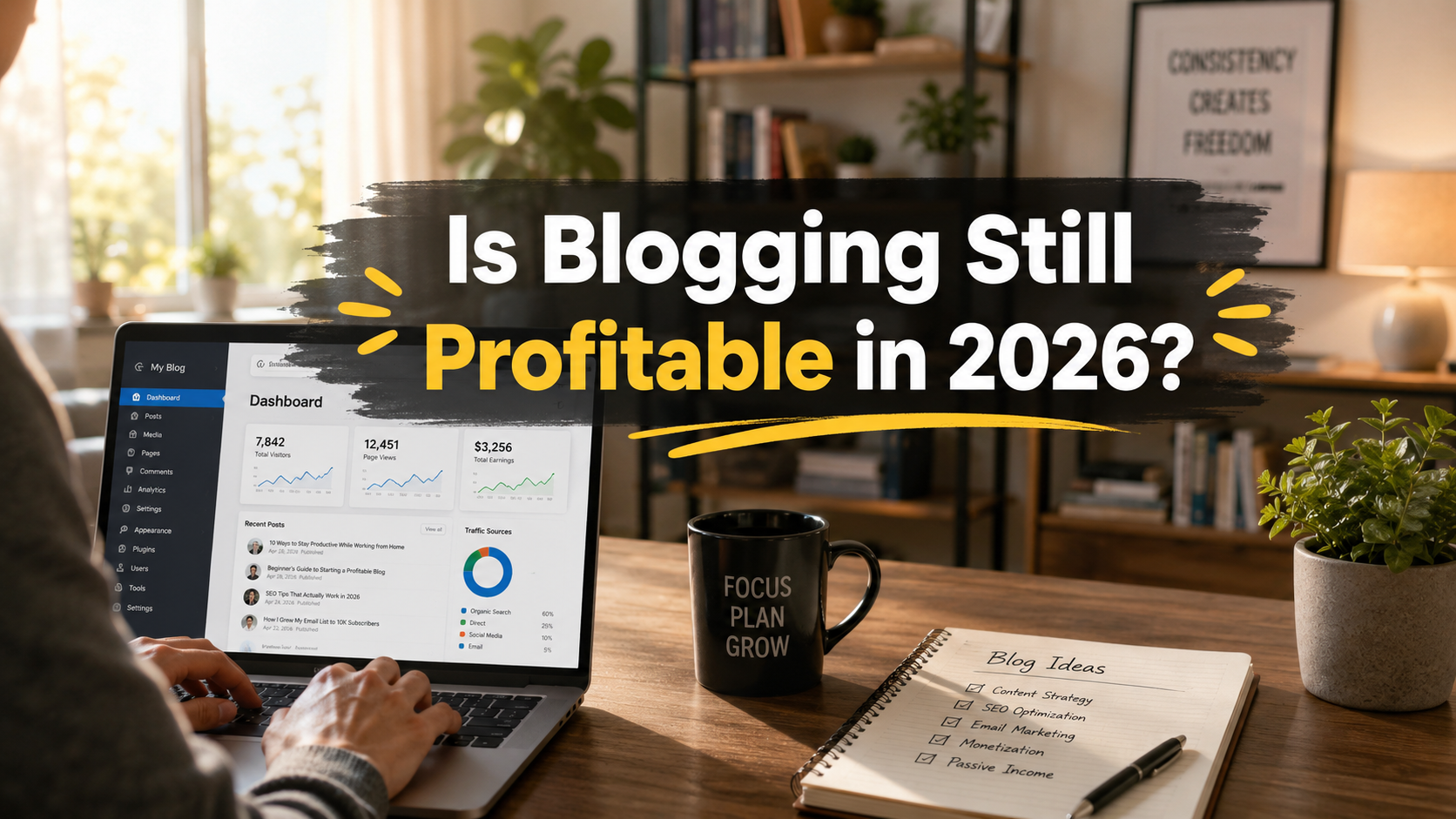
Is blogging still profitable in 2026? See real income data, honest monetization numbers, and a step-by-step plan for building a blog that actually pays off.
If you’ve typed “is blogging dead” into Google at 11 p.m. while staring at a blog that gets ten visitors a day, you’re not alone. Between AI Overviews eating clicks and every “guru” on YouTube declaring blogging finished, it’s a fair question.
Here’s the short answer: blogging is not dead, but the version of blogging that worked in 2015 is. The bloggers still making real money in 2026 are running something closer to a small media business than a hobby with ads on it. The ones struggling are usually still doing what worked a decade ago publish short posts, sprinkle in keywords, wait for traffic.
This article covers what’s actually happening to blog income and traffic right now, which niches are still profitable, how bloggers are realistically earning in 2026, and what it takes to build a blog without wasting a year on the wrong strategy. I’ve spent years building and consulting on content sites through multiple Google algorithm shakeups, and I’ll be straight with you about what’s working and what isn’t.
Is Blogging Dead in 2026? What’s Actually Changed
Blogging isn’t dead but the traffic landscape underneath it has shifted more in the last two years than in the previous decade combined. A few things are true at once, and understanding all of them matters more than picking one narrative.
First, AI-generated answers now show up directly in Google search results for a huge share of informational queries, so fewer people need to click through for a basic answer. Second, the number of blogs and blog posts published every day keeps climbing, so competition for attention is fiercer than ever. Third and this is the part people miss well-researched, experience-backed content is becoming more valuable, not less, because so much generic AI-written filler is now crowding search results. Google’s Helpful Content System was built specifically to reward the first kind of content and bury the second.
So “is blogging dead in 2026” is the wrong question. The better one is whether your blog gives readers something they can’t get from a two-sentence AI summary a tested comparison, a local recommendation, real numbers from real experience. If it doesn’t, that kind of blog is in trouble. If it does, it’s arguably in a better competitive position than it’s been in years, simply because so much low-effort competition is getting filtered out.
How I Make $1,000 a Month in Passive Income : https://insidersdesk.com/2026/08/13/how-i-make-1000-a-month-in-passive-income/
Does Blogging Still Make Money in 2026?
Yes, blogging still makes money in 2026, but the honest picture is uneven. Industry surveys consistently show that only a small share of bloggers earn a full-time income, while a much larger share earn nothing or very little. At the same time, bloggers who treat their site as a proper business combining SEO, email, and multiple income streams regularly report earning $2,000 to $10,000+ a month, and top performers in competitive niches like finance, food, and health go well beyond that.
The pattern that shows up again and again in the data is a power-law distribution: a small percentage of blogs capture most of the revenue, while a long tail of hobby blogs earns close to zero. That’s not unique to blogging it’s true of YouTube channels, Etsy shops, and freelance writing too. The difference between the two groups usually isn’t luck. It’s consistency, niche selection, and whether the blog is built around search intent or just around what the writer feels like writing that day.
If you’re weighing whether to start, the more useful question isn’t “can blogging make money” it clearly can but “am I willing to treat it like a business for 12 to 18 months before expecting real income.” Most blogs that fail don’t fail because blogging stopped working. They fail because the owner quit around month four.
How Bloggers Actually Make Money in 2026
There’s no single blogging business model anymore sites doing best in 2026 usually stack two or three income streams instead of depending on one.
Affiliate Marketing
Recommending products or services and earning a commission on sales remains the single most common way bloggers monetize, particularly in shopping-adjacent niches like tech, home, beauty, food, and personal finance. It works best when the content is genuinely comparative and specific “best budget espresso machines under $200, tested for six weeks” performs better and converts better than a vague listicle with no real testing behind it.
Display Advertising
Ad networks like Mediavine, Raptive, and AdThrive place banner and video ads on your site and pay based on pageviews and engagement. This is largely passive once it’s set up, but it needs meaningful traffic usually tens of thousands of monthly sessions before it becomes worthwhile, and most networks have a minimum traffic threshold to even apply.
Digital Products and Services
Ebooks, templates, courses, coaching, and printables let bloggers sell directly to their audience instead of splitting revenue with an ad network or affiliate program. Margins are far higher, but it requires an audience that trusts you enough to buy, which usually means the blog has been running for a while first.
Email Newsletter Monetization
This is the piece more bloggers are leaning on heavily in 2026, and for good reason. Search traffic can swing wildly with every Google update, but an email list is an asset you actually own. Bloggers who build a newsletter alongside their blog convert casual visitors into repeat readers and customers, which cushions the impact when a single algorithm change dents organic traffic.
Sponsored Content and Brand Partnerships
Once a blog has an established audience in a specific niche, brands will sometimes pay directly for sponsored posts, reviews, or newsletter mentions. This tends to come later, after the blog has traffic and credibility to offer.
The bloggers earning the most consistent income rarely rely on just one of these. A typical profitable setup in 2026 looks like: organic search traffic feeding an email list, affiliate links and ads generating baseline revenue, and a digital product or service providing higher-margin income on top.
How I Make $1,000 a Month in Passive Income : https://insidersdesk.com/2026/08/13/how-i-make-1000-a-month-in-passive-income/
The Most Profitable Blogging Niches in 2026
Niche selection is one of the biggest factors in whether a new blog becomes profitable within a reasonable timeframe. A few categories consistently outperform others:
- Personal finance high advertiser demand and affiliate payouts for financial products, though also highly competitive.
- Food and recipes strong ad RPMs (revenue per thousand pageviews) and reliable, repeat search demand; recipes tend to be genuinely evergreen.
- Health and wellness large search volume, but requires real expertise and careful sourcing, since Google scrutinizes health content closely.
- Home, DIY, and gardening steady seasonal search demand and strong affiliate potential through product recommendations.
- B2B and software (SaaS) lower traffic volume but very high-value leads and partnerships, making it attractive for bloggers comfortable with a smaller, more specialized audience.
- Travel rebounding steadily, though it’s a slower, more competitive niche to break into from scratch.
The niches struggling most right now are broad, generic “lifestyle” blogs with no clear focus, and topics almost entirely answered by a quick AI summary think basic definitions or simple conversions. The winning move isn’t necessarily the highest earning niche on paper; it’s a niche where you have genuine knowledge or hands-on experience, because that’s exactly what Google’s quality systems and skeptical readers are looking for.
How to Start a Blog in 2026 (Without Wasting Your First Year)
Starting a blog is technically simple. Making it profitable is where most people go wrong, usually in the first few decisions.
1. Pick a Focused Niche, Not a Broad Topic
“Travel” is not a niche. “Budget solo travel for people over 50” is. A tighter focus helps you rank faster, because you’re not competing directly against massive, established sites for every single keyword.
2. Do Keyword Research Before You Write Anything
Keyword research tells you what people are actually typing into Google, how much competition exists for that phrase, and just as important what they expect to see when they search it. Free tools like Google’s own Keyword Planner or the “People also ask” and autocomplete features can get you started; paid tools like Ahrefs or SEMrush go deeper once you’re serious. Skipping this step is the single most common reason new blogs stay stuck at zero traffic.
3. Match Search Intent, Every Time
Search intent means understanding why someone typed a particular query. Someone searching “how to make money blogging in 2026” wants a practical breakdown, not a philosophical essay on the creator economy. Someone searching “best blogging platform” wants a comparison, not your personal origin story. Misjudging intent is why well-written articles sometimes still fail to rank Google can tell when a page doesn’t match what searchers actually wanted.
4. Choose the Right Blogging Platform
WordPress still powers the largest share of blogs worldwide and gives you full ownership and flexibility, which matters for long term SEO and monetization control. Hosted platforms like Substack or Ghost work well if your priority is newsletter first publishing rather than search traffic. There’s no universally “best” platform it depends on whether search or email is your primary growth engine.
5. Prioritize Evergreen Content Early On
Evergreen content guides, tutorials, and resources that stay relevant for years rather than days compounds over time, bringing in traffic long after publication. News and trend-based posts can drive short bursts of traffic but rarely build a stable income base on their own. A healthy content calendar leans heavily evergreen with occasional timely posts mixed in.
6. Publish Consistently, But Prioritize Depth Over Frequency
A single genuinely useful, well-researched 2,000-word guide will typically outperform five rushed 500 word posts. Consistency matters for building topical authority, but it should never come at the cost of depth.
How to Get Traffic to Your Blog in 2026
Google is still the single largest traffic source for most blogs, but relying on it exclusively is riskier than it used to be, given how much real estate AI-generated answers now occupy on the results page. A stronger approach spreads traffic across a few channels.
Organic search (SEO) remains the foundation. Ranking well requires a genuine SEO blogging strategy: solid on-page optimization, internal linking between related posts, decent page speed, and increasingly content that demonstrates real experience rather than information gathered secondhand. Google’s ranking systems are explicitly built to reward the former and demote the latter.
Email newsletters deserve more attention than most new bloggers give them. Every subscriber is someone you can bring back to your site directly, without depending on an algorithm’s mood that week. Starting your list on day one, not once you “have enough traffic to justify it,” pays off later.
Pinterest still sends meaningful referral traffic for visual niches like food, home, and crafts, and its search like discovery model rewards well optimized, evergreen pins for a long time after posting.
Social platforms and forums like Reddit or niche Facebook groups can drive early traffic and, just as valuably, real feedback about what your audience wants feedback that’s hard to get from analytics alone. Repurposing a post into a short video or newsletter feature also helps a single piece of content work harder.
If you only take one thing from this section: don’t put all your traffic eggs in the Google basket, even though it should still be your biggest one. Diversifying isn’t optional caution anymore it’s a basic hedge against a search results page that keeps changing shape.
What’s a Realistic Income Timeline?
This is the part most “make money blogging” content skips, and it’s what matters most when deciding whether to commit.
Most blogs earn effectively nothing for the first six months that’s normal, not failure. It takes time for Google to trust a new site and for content to climb the rankings. Between months six and twelve, a well-run blog in a reasonable niche typically starts seeing modest, sporadic income: a few affiliate sales here, some small ad revenue there. The twelve to eighteen-month mark is where blogs either hit their stride, with compounding traffic and diversified income, or stall because the writer lost momentum before the content had time to mature.
Blogs that reach meaningful income a few thousand dollars a month almost always share three traits: a clear niche, consistent publishing over at least a year, and multiple monetization methods rather than one. There’s no shortcut around the time investment, and anyone promising overnight blogging income in 2026 isn’t being straight with you.
Frequently Asked Questions
Is blogging still worth starting in 2026? Yes, if you’re realistic about the timeline and pick a focused niche where you have genuine knowledge or experience. It’s not a get-rich-quick path, but it’s still one of the few online business models where you own the asset outright and can build income streams that don’t depend on a single platform’s algorithm.
How long does it take for a blog to make money? Most blogs take six to twelve months to see consistent income and twelve to eighteen months to reach meaningful, stable revenue. This varies by niche competitiveness, publishing consistency, and how well the content matches real search intent.
How much do bloggers actually make per month? It varies enormously. Many blogs earn little to nothing, while established bloggers with a focused niche and multiple income streams commonly report $2,000 to $10,000+ per month, and top performers in high-value niches like finance or food can earn considerably more.
What is the most profitable way to monetize a blog? There’s no single “best” method most profitable blogs combine affiliate marketing, display advertising, and an email list, with some adding digital products or sponsorships once their audience grows. Relying on just one income stream is riskier than stacking two or three.
Do I need to use AI to write a blog in 2026? You don’t need to, but most successful bloggers use AI tools for research, outlining, or first drafts, then rely heavily on personal experience and editing to make the final piece genuinely useful. Content that reads as generic or clearly unedited AI output tends to underperform, both with readers and with Google’s quality systems.
The Bottom Line
Blogging in 2026 isn’t dead, but it’s no longer a low-effort side hustle either. The blogs still winning are the ones built around a focused niche, real expertise, solid keyword and search-intent research, and more than one way to earn search traffic feeding an email list, backed by affiliate income, ads, or products. The blogs that fail usually aren’t victims of AI or algorithm changes; they’re blogs that stopped showing up before the compounding effects of good SEO had time to kick in.
If you’re ready to move from research to action, the next practical step is mapping out your niche and running proper keyword research before you publish a single post that groundwork saves months of trial and error down the line. And if you already have a blog that’s stalled, it’s often worth a closer look at your content’s search intent match and topical depth before assuming the traffic just isn’t out there anymore.

Muqit is an author at Insiders Desk, creating simple and practical guides to online business and digital income. He writes about business models, digital tools, SEO, content creation, and monetization methods, with a focus on clear explanations, realistic expectations, and informed decision-making. His content is educational and does not promise guaranteed income or business results.
Leave a Reply