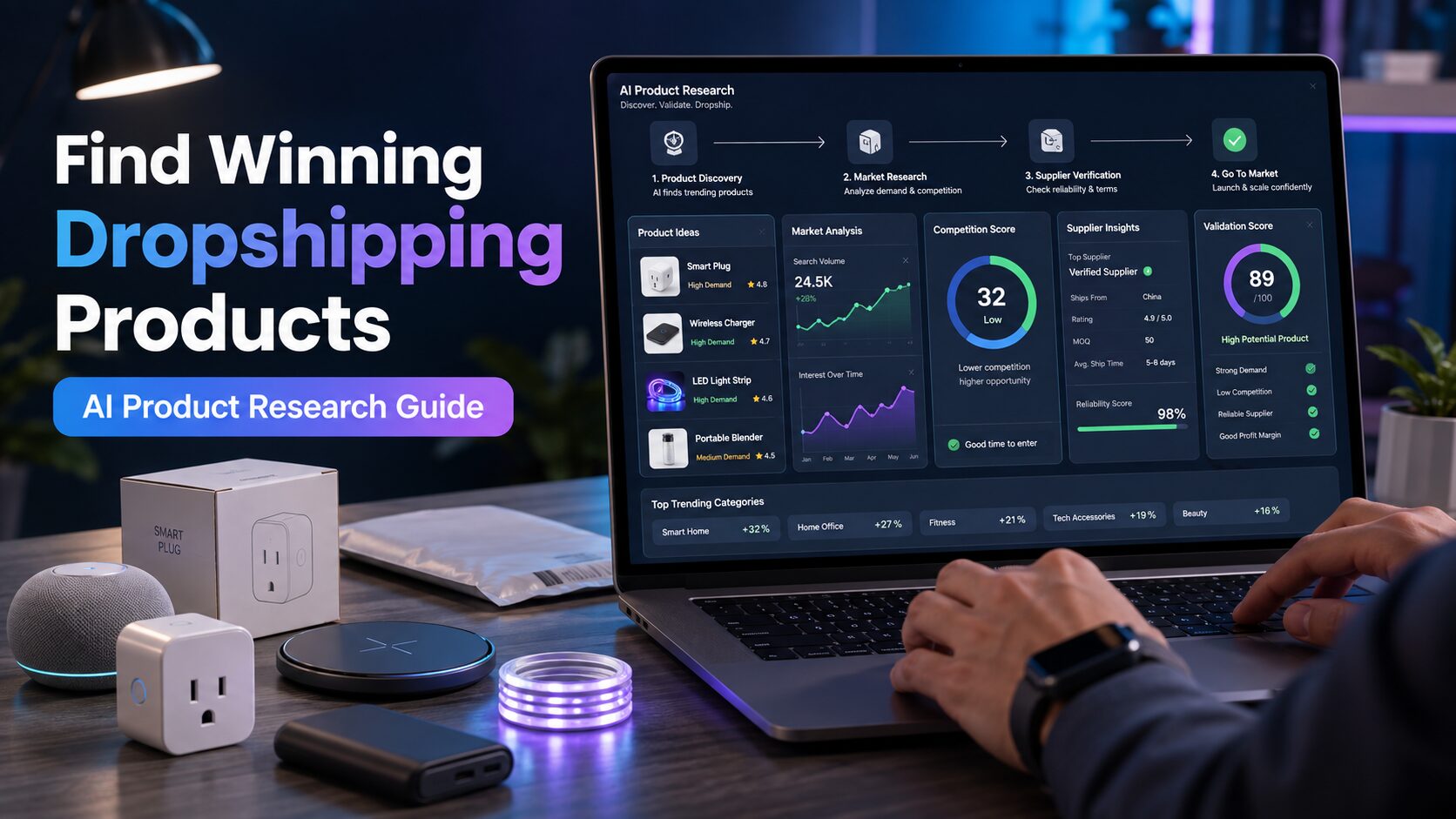
I lost $340 on my first dropshipping product. And before you assume I blew it on Facebook ads, I didn’t. I pre-ordered physical stock from a supplier because I was certain I’d found a winner waterproof phone pouches for swimmers. Google Trends showed a seasonal spike. TikTok had a few videos of people using them at the beach. I thought I’d done my homework.
The supplier had a 28-day shipping window. By the time my first customer received their order, summer had ended across most of the US. Two refund requests and one review that read: “Arrived in October. Needed it in July.”
That single $340 mistake taught me more about finding a product to dropship than every YouTube course I’d ever watched. Over the past four years, I’ve tested dozens of products across multiple niches, built a process that’s repeatable, and learned exactly where most beginners go wrong. This guide is what I wish existed when I started.
Why “Winning Product” Lists Are Already Dead Before You Read Them
Every week, someone posts “10 best dropshipping products for this month.” By the time that list circulates, most stores worth competing with have already tested and moved on from those picks. Finding dropshipping products from curated trend lists isn’t product research it’s arriving late to a party where the food is gone.
The real opportunity in 2026 is not finding what’s already winning. It’s finding what’s about to win, or identifying a better angle on something that’s already proven demand but has weak execution in the market. That shift in thinking is the foundation of everything else in this guide.
The best dropshipping niches 2026 are not the ones getting plastered across Reddit threads. They’re the ones where you’ve spotted a customer complaint that nobody has solved well yet.
How AI Actually Helps When Finding Dropshipping Products (And Where It Falls Short)
AI tools can speed up your research significantly but only if you use them correctly. The mistake most beginners make is asking AI to hand them the answer. Prompts like “give me the best dropshipping products 2026” will return generic, surface-level results that every other person using the tool is seeing too.
The approach that actually works is using AI as a thinking partner to explore frustrations.
Instead of asking for products, I ask things like:
- “What are recurring frustrations people have when working from a home office that a physical product could solve?”
- “What complaints do pet owners in small apartments have that aren’t well addressed by current products?”
- “What are common problems travelers face with carry-on luggage organization?”
That frustration-first framing generates genuinely useful output. From the home office prompt, I’ve gotten ideas like: webcam positioning for laptop users on video calls, monitor arm wobble, and cables sliding off desks real, specific problems with real, searchable demand.
I cross-reference those ideas using search tools that pull from forums, reviews, and current market data to check whether a product concept already has supplier availability and what people are actually saying about existing options.
What AI cannot do: It cannot confirm whether your specific supplier is trustworthy, whether your margins will hold, or whether a product will convert for your audience. That part requires real-world verification which we’ll cover below.
My Step-by-Step Process for Finding Products to Dropship
This is the exact sequence I run through every time I evaluate a potential product. It takes 2 4 hours when done properly. Cutting corners in any step is usually what leads to a dead product launch.
Step 1: Start With a Frustration, Not a Product Category
Pick a specific audience. Remote workers. Parents with toddlers. Dog owners in apartments. People who travel for work 10+ times a year. Then ask: what problem are they solving today with something clunky, overpriced, or outdated?
The audience-first approach is what separates people who are consistently finding dropshipping products with real demand from people who are browsing AliExpress catalogs hoping something jumps out.
Step 2: Map the Gaps in Existing Solutions
Once I have a frustration, I spend about 20 minutes exploring what products currently exist for it, what those products do well, and most importantly what customers consistently complain about.
If the leading solution on Amazon is bulky, breaks within 90 days, or doesn’t fit a common use case, that’s not a red flag. That’s a product brief. The complaint is the spec for a better version.
This phase works well with AI tools that can pull information from multiple sources quickly. I’ll often ask follow-up questions like: “What do the most common negative reviews about [product type] say? What feature do people most wish was different?”
Step 3: Validate on Amazon Before You Touch a Supplier
Amazon is not a sales channel for this step it’s a research database. Search the product category, sort by “most reviews,” and go straight to the 3-star reviews.
Skip the 1-stars. They’re often outliers, defective units, or competitor manipulation. Skip the 5-stars they’re not going to tell you what’s wrong. The 3-star reviews are from real customers who liked the product enough to keep it but had one specific, consistent frustration.
That frustration is the exact angle you need to position your product around. Read 40 60 of them before moving on.
Step 4: Use Google Trends to Separate Sustainable Demand From Spikes
Most people misread Google Trends. They see a spike in the past 30 days and call it a signal. A spike is not a signal. A spike is noise until proven otherwise.
Pull a 5-year view. What you’re looking for when identifying trending products to dropship is one of two things:
- Steady, consistent growth over 24 36 months this is a product with real momentum
- Clear seasonal patterns where you can plan inventory and ad spend timing in advance
A product with a 5-year upward trend in searches is far more valuable than something that had a viral moment last month and is already declining.
Also check the geographic breakdown. If 80% of interest is concentrated in one region and your logistics don’t support that market affordably, factor that in early especially if you’re looking at high demand products to ship from USA to UK in 2026 or similar cross-market opportunities where the interest map matters for fulfillment decisions.
Step 5: Spend 15 Minutes on TikTok (Searching Correctly)
Go to TikTok and search the product directly. Look at regular search results, not the shopping tab. The shopping tab shows you what’s already being sold at scale you want to see organic content.
Filter your attention to videos with 50,000 300,000 views. That range is the signal zone. Under 50k is too early to confirm demand. Over 300k 500k usually means you’re seeing a saturated product that everyone and their supplier has already pivoted toward.
The best demand signal I’ve found on TikTok is a specific comment type: “Where did you get this?” When that question shows up repeatedly on multiple videos for the same product, that’s genuine purchasing intent from people who don’t know where to buy it yet. That’s the gap.
Step 6: Open the Meta Ad Library Before You Contact Any Supplier
Meta’s Ad Library is free, public, and massively underused for dropshipping product research. Search the product name, filter to active ads.
Zero results: Either you’ve found a gap, or there’s no market. You need the other signals to determine which. Don’t assume zero ads means zero competition sometimes it means zero demand.
5 15 active ads from different brands: Healthy signal. The product sells. Study the creative angles they’re using and find where they’re not positioning.
30+ active ads: Competitive market. Not impossible to enter, but you need a sharper angle, better creative, or a niche audience that the current ads aren’t speaking to.
Step 7: Order a Sample Before You List Anything
I use AliExpress for initial supplier vetting and have also sourced through Alibaba dropshipping arrangements for better pricing at lower MOQs once I’ve validated demand. Both have their tradeoffs AliExpress is faster for sampling, Alibaba often gives you more room to negotiate on quality specs.
But regardless of where you source: order the sample first. Every time. Without exception.
I’ve been burned by products that looked professional in supplier photos and arrived looking like they’d been thrown together in the dark. You cannot confidently sell something you haven’t physically held and tested.
When the sample arrives, note the actual delivery date. Not the listing estimate the real one. That number goes directly into your pre-launch planning.
The Real Margin Math (What Most Guides Conveniently Skip)
A lot of dropshipping content shows you a product cost of $8 and a selling price of $29 and implies that $21 margin is yours to keep. It isn’t. Here’s how the math actually works.
The Full Cost Stack
| Cost Component | Notes |
|---|---|
| Product cost | Your supplier invoice price |
| Shipping to customer | If not built into product cost |
| Platform fee | Varies by where you sell |
| Payment processing | Typically ~2.9% + $0.30 per transaction |
| Return reserve | Budget 5% of revenue; returns happen in every category |
| Ad spend (if applicable) | Cost per acquisition must come from your margin |
The Minimum Margin Threshold
After subtracting every cost above before advertising, you need at least 30 35% of the selling price left over to have a viable product if you plan to run paid ads. If you’re using only organic channels (SEO, social, content), you can work with 25–28%, but your growth ceiling will be slower.
I walked away from three products last year that looked attractive on the surface. One had a 38% gross margin that compressed to 11% after fees, realistic return rates for the category, and a conservative cost-per-acquisition estimate. That 11% is not a business it’s an unpaid part-time job.
Do the full calculation before you order samples. If it doesn’t survive the math, no amount of good creative will save it.
How to Score a Product Before You Commit
Before I move a product from “researched” to “launch ready,” I score it across five dimensions. Each scored 1–5. Anything below 18/25 gets dropped.
| Dimension | What I’m Evaluating |
|---|---|
| Demand clarity | Can I find consistent search and purchase intent without digging hard? |
| Trend trajectory | Is interest growing, stable, or declining on a 5-year view? |
| Margin viability | Does it survive the full cost stack at a realistic price point? |
| Differentiation room | Is there a genuine angle competitors are missing? |
| Supplier reliability | Did the sample arrive on time and match the listing? |
Products that score 22–25 get a proper launch. Products scoring 18 21 get a small organic test first. Below 18, I move on and document why — those notes have saved me from repeating the same type of mistake twice.
Real Example: Finding a Profitable Product Last Quarter
I was back in the home office niche, which I return to regularly because demand there is consistent and it’s one of the best dropshipping niches for 2026 given the sustained growth in remote work culture.
The frustration I landed on: monitor arm wobble. If you’ve used a monitor arm, you know it every keystroke sends a slight vibration through the arm and into the screen. It’s minor, but it’s persistent and annoying.
I searched Amazon. The top-reviewed monitor arms all had 3 star complaints concentrated around two things: instability at the joint and a clamp that didn’t grip desks with non-standard thickness. I read about 60 of those reviews.
Google Trends showed consistent 5-year growth for “monitor arm” in both the US and UK a promising signal for anyone looking at high demand products to ship from USA to UK in 2026, since both markets had strong interest without an obvious dominant brand at the mid-price tier.
I sourced through AliExpress first, found a supplier with a heavy-duty joint design and a C-clamp rated for thicker desk surfaces. Ordered a sample. It arrived in 18 days (the listing said 10 15, which I expected to be optimistic). Felt genuinely solid. Passed the sample test.
Meta Ad Library: a handful of competitors, but none were specifically talking about stability. Every ad led with aesthetic or cable management. I led with stability and desk compatibility. That was the angle.
It’s not my biggest earner. But it runs profitably on a small daily ad budget, maintains a 4.6-star average, and has had no supplier issues in four months. That’s what finding a good dropshipping product actually looks like methodical, slightly tedious, and not at all a lightning bolt moment.
Mistakes That Cost Me Money (So You Don’t Have To)
Chasing viral instead of validated demand. A product going viral on TikTok is a traffic event. Validated demand is a purchasing pattern that exists next month and the month after. These are different things. Viral spikes get you a week of clicks; sustainable demand pays your operational costs in month six.
Trusting supplier shipping estimates. Order the sample. Time the delivery yourself. The listing is marketing, not a contract.
Choosing products that need education to sell. If your ad has to explain why someone needs the product before it can ask them to buy it, your conversion rate will reflect that extra friction. The best dropship finds are immediately understood you see it, you want it, you get it.
Ignoring category return rates. Electronics accessories, apparel, anything with complex setup instructions these categories carry higher baseline return rates. Build that into your margin model before launch, not after your first bad month.
Testing too many products simultaneously. My profitable runs have always come from going deep on one or two products. Spreading across fifteen tests at once means you’re collecting less learning per dollar spent and optimizing nothing properly.
Frequently Asked Questions About Finding Dropshipping Products in 2026
Is AI good for dropshipping product research?
Yes, but only as a research accelerator, not a decision-maker. AI tools are genuinely useful for brainstorming customer frustrations, identifying product gaps from review patterns, and quickly cross-referencing market presence. They can’t tell you whether your specific supplier is reliable or whether your margins will actually work that part still requires hands-on verification.
Can AI find winning products for dropshipping?
Not directly. If you prompt an AI tool to just “give you winning products to dropship,” the output will be generic and widely shared meaning anyone else using the same prompt sees the same results. The better use is asking AI about customer frustrations and existing product complaints, then using those inputs to guide your own Amazon and TikTok validation work.
How many products should beginners test?
Start with one or two, done properly. The common beginner instinct is to test ten products at once hoping one sticks. That approach splits your budget, splits your attention, and generates weaker learning from each test. One product researched thoroughly and launched with a real margin calculation teaches you far more than fifteen half-baked launches.
How much money do I need to start dropshipping?
For a realistic start not a paper exercise budget between $300 and $800. That covers: your store platform for a few months, 2 3 product samples, and a small initial paid ad test if you’re not going organic-only. Going in with less is possible but tight; going in with significantly more before you’ve validated your first product is unnecessary.
Is dropshipping dead in 2026?
No, but the version of it that worked in 2018 picking trending products to dropship from a catalog, running broad Facebook ads, and waiting for margin is dead. Dropshipping in 2026 requires tighter margin math, supplier relationships that support faster shipping, and product positioning that’s specific enough to compete in a crowded ad environment. The people calling it dead are usually describing the old model, not the current one.
What product categories should beginners avoid?
Avoid categories with high explanation requirements, high return rates, or heavy size/fit dependency until you have some experience with returns handling. Specifically:
- Electronics with multiple setup steps return rates are high and customer service is time-intensive
- Apparel and footwear sizing complaints and returns will eat into thin margins fast
- Fragile items with long shipping routes damage claims are unpredictable
- Anything FDA-regulated supplements, cosmetics, and certain health products have compliance requirements beginners often underestimate
Start in home, office, outdoor lifestyle, or pet categories where products are easier to photograph, describe, and return if needed.
How do I know if a product is already saturated?
Several signals point to saturation:
- Meta Ad Library shows 30+ active ads from multiple brands using identical creative angles
- Google Trends shows a single sharp spike followed by decline, not sustained growth
- Amazon search shows page 1 dominated by established brands with 10,000+ reviews
- TikTok search results are flooded with videos over 500k–1M views for the same product
Saturation isn’t always fatal sometimes a saturated product just needs a sharper audience angle. But for beginners without established ad accounts and budget, finding dropshipping products with less competition is usually the smarter starting point.
What’s the difference between best dropshipping niches 2024 and what works in 2026?
The profitable dropshipping niches 2026 differ from 2024 primarily in consumer expectations, not category. Customers now expect faster domestic or near-domestic shipping (7–12 days), better product photography, and more specific problem-solving. Categories that were strong in 2024 — home office, outdoor/recreation, pet accessories remain among the best niches for passive automated dropshipping when paired with a supplier that can meet those logistics expectations. What’s changed is the bar for execution, not the underlying demand categories.
Final Thought
The best skill you can build in this space is pattern recognition and that only comes from attempts, not from reading guides.
You will pick products that flop. Experienced operators do too. What separates people who build something that lasts from people who quit after three months is whether they treat each failed product as a data point or as proof the whole thing doesn’t work.
Every bad pick taught me something concrete: what “seasonal” really means when your shipping window is 21 days, how to read a return rate before it becomes a problem, which supplier promises hold and which don’t.
The research process I’ve described above compresses a lot of that learning. But judgment still has to be earned through actual launches, real return data, and the occasional uncomfortable conversation with a customer who is not happy with what arrived.
That part doesn’t have a shortcut.
Disclosure: This article contains no affiliate links. All tools and platforms mentioned are based on personal use across four years of building and testing dropshipping stores. This is not financial or business advice — results vary based on niche selection, execution, market conditions, and capital available.

Muqit is an author at Insiders Desk, creating simple and practical guides to online business and digital income. He writes about business models, digital tools, SEO, content creation, and monetization methods, with a focus on clear explanations, realistic expectations, and informed decision-making. His content is educational and does not promise guaranteed income or business results.
Leave a Reply