Spend ten minutes searching for side hustles and you’ll find no shortage of ideas. The problem is that many of them sound far easier in an article than they are when you actually try to make money from them.
“Start freelancing.” “Become a virtual assistant.” “Make money testing websites.”
None of those ideas is necessarily bad. They’re just incomplete.
The part that tends to get skipped is finding the first client, convincing someone to pay you, qualifying for the work, dealing with revisions, or discovering that a supposedly well-paid project takes twice as long as expected.
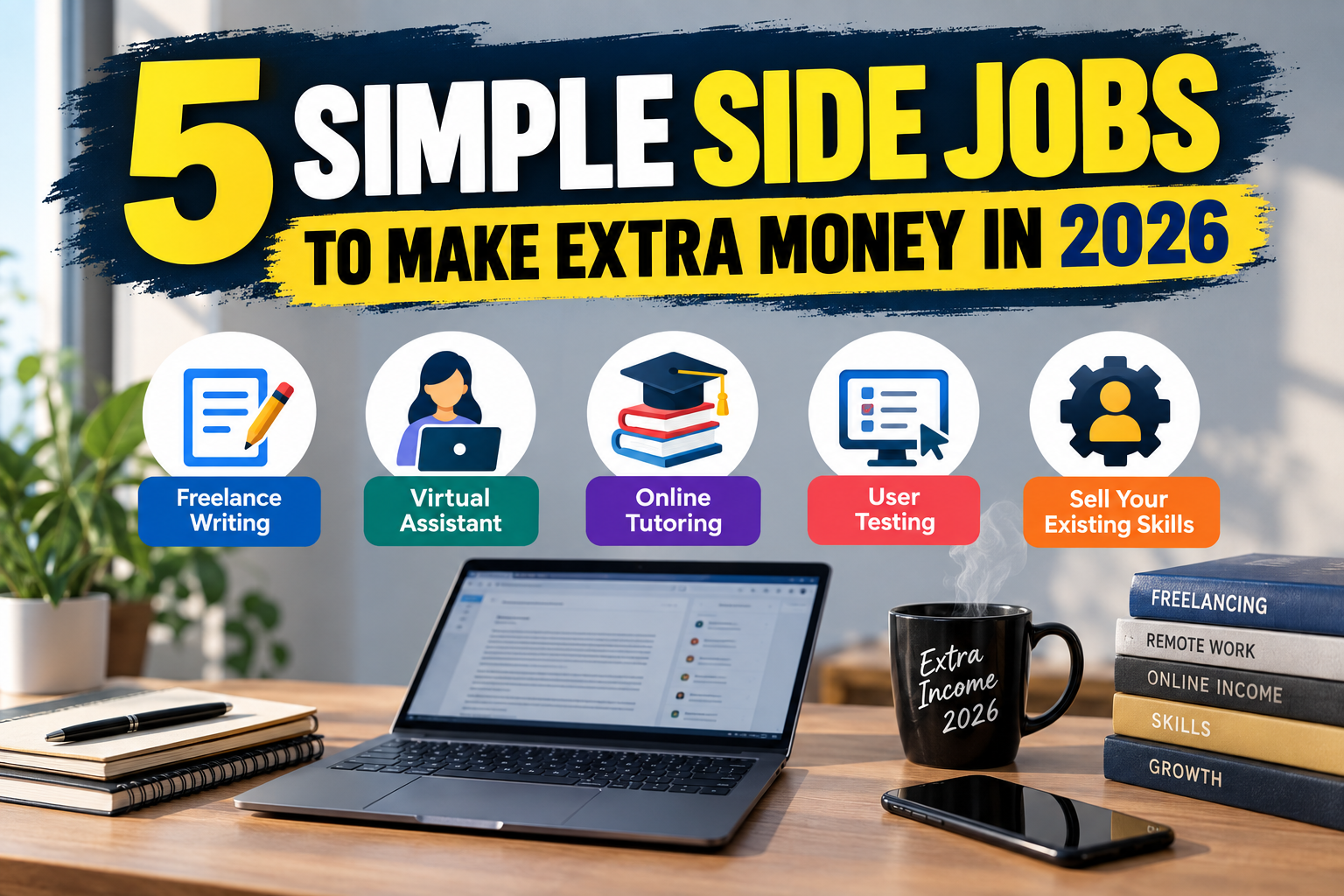
That’s why I’d rather focus on five fairly ordinary options: freelance writing, virtual assistant work, online tutoring, user testing, and selling a skill you already have.
They’re not shortcuts to easy money. They’re simply realistic places to start if you already have a computer, an internet connection, and something useful to offer.
More importantly, you don’t need to try all five.
1. Freelance Writing: Easy to Start, Harder to Sell
Getting started as a freelance writer is surprisingly simple.
You can open a blank document today, write three good articles, and technically have the beginning of a portfolio.
Getting someone to pay for those articles is another matter.
Businesses hire writers for blog posts, website copy, newsletters, product descriptions, case studies, documentation, and plenty of other work. A formal writing degree isn’t always necessary. Being able to research a topic properly, follow instructions, write clearly, and meet a deadline is often more relevant.
If you have no clients yet, I wouldn’t spend weeks worrying about that empty portfolio.
Create your own samples.
Interested in cybersecurity? Write about phishing, password security, and security tools. Interested in personal finance? Pick a few tightly focused topics in that area instead.
Just call them what they are: samples.
There’s no need to manufacture a fake client history to make yourself look established.
Another thing I’d avoid is presenting yourself as somebody who writes “about anything.”
It sounds flexible, but it doesn’t give a potential client much reason to remember you.
“I write cybersecurity content for software companies” is a much clearer proposition than “I can write articles on any topic.”
Once you have something worth showing, places such as Upwork, Contra, LinkedIn, relevant job boards, and direct outreach can all be used to look for work.
But joining five platforms on the same day probably won’t solve the difficult part. You still need a convincing offer and good work.
And when a project finally comes along, don’t become too impressed by the headline price.
A earn money writing online that takes two hours is very different from a $100 article that consumes an entire day through research, messages, revisions, and formatting.
What matters is closer to:
Money received ÷ all the time you actually spent
That’s a less exciting number, but a much more useful one.
2. Virtual Assistant Work Is Broader Than It Sounds
“Virtual assistant” can be a frustratingly vague job title.
One VA might spend most of the day dealing with email and calendars. Another could update WordPress posts, manage spreadsheets, research information, upload products, or keep a project-management system organized.
That’s actually good news for beginners because you may already know several useful tools without considering them professional skills.
Someone comfortable with Google Docs, spreadsheets, email, and WordPress already has a combination that could be useful to a small website owner.
I’d rather see a beginner confidently offer four things they can genuinely do than list 20 apps they barely understand.
You can find VA opportunities through Upwork, LinkedIn, freelance marketplaces, remote-job boards, and direct outreach.
Pay attention to the arrangement, though.
A flexible remote role and a role that requires you to sit online from 9 to 5 in somebody else’s time zone are both technically “remote work,” but they’ll feel completely different in practice.
This matters even more if you’re studying, already employed, or trying to build a side income around other responsibilities.
Recurring clients are also worth thinking about. Constantly finding new $20 jobs can become exhausting. One decent client who needs regular help may be more useful than repeatedly returning to a marketplace to start from zero.
No previous client work? Make something.
Create a sample project tracker. Organize a fictional spreadsheet. Document a simple WordPress publishing workflow.
Proof beats a paragraph full of claims about how “detail-oriented” you are.
3. Online Tutoring Works Best When You Narrow It Down
Tutoring is one of the more straightforward ideas here: you know something, someone else wants to learn it, and you help them understand it.
The difficulty is that “I teach programming” or “I teach mathematics” doesn’t say very much.
I’d narrow the offer.
For example:
Beginner Python tutoring for high-school and first-year university students.
Now there’s a clear subject and a clear student.
You can even imagine what the first few lessons would look like: variables, conditions, loops, functions, then perhaps a small beginner project.
Depending on the subject and platform, you may need a computer, microphone, webcam, stable internet, and lesson materials. Some platforms also have requirements involving identity, age, qualifications, location, or the subjects you’re allowed to teach.
Preply is one platform associated with online tutoring, while LinkedIn, referrals, educational communities, and independent tutoring are other routes.
The advertised lesson rate isn’t the whole story.
A one-hour class might require preparation beforehand, messages with the student, homework review, and follow-up afterward. If you’re spending 90 minutes of your time to deliver a 60-minute lesson, evaluate it as 90 minutes.
The attractive part is repeat business.
If a student likes the way you teach, they may book again. Over time, that can be far more predictable than constantly searching for somebody new.
4. User Testing Isn’t Really Freelancing
User testing gets grouped into side-hustle lists all the time, but I think it’s useful to separate it mentally from freelancing.
You’re generally not finding a client and selling them a professional skill.
Instead, you might be asked to use a website, app, prototype, or another digital product while explaining what makes sense, what doesn’t, and where you get confused.
Platforms such as UserTesting and User Interviews operate in this broader research space.
The work itself may sound simple. The availability of work is the catch.
Research studies often need very particular participants. You might encounter several screening questions only to discover that you don’t fit what that study needs.
That’s normal.
It also means I wouldn’t build a monthly budget around the assumption that user testing will give you a predictable number of paid hours.
If a study shows its compensation and expected duration, by all means compare the money with the time involved. Just remember that a good rate on one study doesn’t mean another suitable study will immediately appear afterward.
Treat it as opportunity-dependent income.
And don’t try to game screening questions. Researchers are looking for particular people for a reason. Giving answers purely because you think they’ll qualify you defeats the point of the research.
Of the five options here, this is the one I’d be most comfortable treating as occasional extra money rather than something inherently consistent.
5. Before Learning a New Side Hustle, Look at What You Already Know
This is probably the part of side-hustle advice I think gets backwards most often.
People immediately ask, “What new skill should I learn to make money?”
A better first question might be:
What can I already do that somebody else finds useful?
Maybe you’ve spent the last year learning WordPress.
Maybe you edit videos, build websites, design graphics, translate, work with spreadsheets, understand SEO, create presentations, analyze data, or do bookkeeping.
You don’t necessarily need another skill. You may need a better way of packaging the one you already have.
Suppose you know WordPress.
You could advertise yourself as someone who does:
WordPress, SEO, writing, logos, social media, programming and digital marketing.
It’s a long list, but I don’t think it’s a particularly convincing one.
WordPress website setup for small businesses is narrower, but at least I immediately understand what you’re selling.
Then prove it.
Build a restaurant website. Build a site for a fictional local service business. Build your own portfolio.
They aren’t client projects, so don’t pretend they are. But they’re still evidence that you can sit down and produce something.
That’s far more valuable than an empty portfolio.
Once you have that proof, marketplaces such as Upwork, Fiverr, Contra, and LinkedIn are possible places to look. Professional communities and direct outreach are other options.
Marketplaces give you access to buyers but also put you beside plenty of competitors. Direct outreach removes some of that marketplace competition, but now finding suitable prospects is your job.
Neither route magically removes the selling part.
And again, watch your time.
If somebody pays you $100 for a project and it consumes 10 hours after meetings, messages, revisions, and the actual work, that’s $10 per hour before other relevant costs.
If experience eventually lets you deliver comparable work in five hours, you’ve changed the economics without changing the project price.
Getting better at the work matters.
So, What Would I Start With?
I’d start with the option closest to a skill I already have.
If you can write well, I’d test writing before spending six months learning graphic design just because somebody called it a profitable side hustle.
If you’re organized and comfortable with office tools, look at VA work.
If you’re genuinely good at explaining a subject, tutoring makes sense to investigate.
If you only want occasional opportunities and don’t want to sell a professional service, user testing is worth looking at.
And if you’ve already spent months or years developing something useful—WordPress, video editing, design, coding, SEO, bookkeeping—I’d first see whether that can be turned into a focused service.
This isn’t because learning new skills is bad.
It’s because starting from zero has a cost, and people routinely ignore it.
The Numbers Are More Useful Than the Hype
Here’s something I’d track from the beginning:
Time spent, applications sent, responses received, projects completed, fees paid, and money actually received.
You don’t need a sophisticated dashboard. A spreadsheet is enough.
Suppose you send 50 proposals and nobody responds.
That’s disappointing, but it’s also useful information. Maybe your portfolio is weak. Maybe the offer is too generic. Maybe you’re approaching the wrong clients. Maybe your proposals look exactly like everybody else’s.
Now suppose you make $200.
Great—but how long did it take?
If earning that $200 consumed 40 hours, that’s an important part of the story too.
This is why I’m skeptical of side-hustle content built almost entirely around screenshots of revenue. Revenue without time, expenses, and context doesn’t tell you very much.
The same applies when someone asks, “How much can I make?”
There isn’t one honest answer.
A writer with three recurring clients isn’t comparable to someone who created an Upwork profile yesterday. A tutor with regular students isn’t in the same position as someone preparing their first lesson. And user testing depends heavily on whether suitable studies are available and whether you qualify.
I’d worry less about finding a universal earning estimate and more about finding out what your effective return on time looks like.
Don’t Let “Easy Money” Override Common Sense
Anything involving online income attracts scams.
The obvious pitch is usually some variation of high income, almost no work, and an urgent reason you need to act today.
That’s when I’d become more cautious, not less.
Large payments required just to access a supposed job, requests for passwords or authentication codes, unexplained money transfers, suspicious recruiter identities, and vague descriptions of what you’ll actually be doing are all reasons to investigate further.
Legitimate platforms may ask for identity or payment information as part of their normal processes. The important thing is verifying that you’re actually dealing with the real company and using its genuine website.
You Can Be a Beginner Without Looking Unprepared
There’s also a difference between having no professional experience and having nothing to show.
A new writer can have three excellent samples.
A new VA can have a demonstration workflow.
A new tutor can have a well-designed lesson.
A new WordPress freelancer can have several demonstration websites.
None of those things should be misrepresented as paid client work. They don’t need to be.
They’re simply proof that you’ve taken the skill beyond saying, “Trust me, I can do it.”
That’s a much stronger place to start.
Start Smaller Than You Think
If I were starting from scratch, I wouldn’t create six accounts, learn four new skills, and apply to 100 random jobs in the first week.
I’d choose one thing I could already do reasonably well.
Then I’d build enough proof to show it, choose one or two realistic ways of finding people who need it, and see what happens.
If nobody responds, I’d look at the evidence before deciding the idea doesn’t work. Is the offer too broad? Are the samples good enough? Am I contacting the right people? Does my profile actually explain what I do?
I’d adjust and test again.
But I also wouldn’t keep forcing an idea for months simply because an influencer promised it was a “side hustle” that makes $5,000 a month.
Eventually your own numbers should have more influence over your decisions than somebody else’s income screenshot.
That’s probably the least glamorous advice in this article, but it’s the part I’d pay the most attention to:
Start with something useful. Prove you can do it. Test whether people will pay for it. Then follow the evidence.
One Last Note About the Platforms Mentioned Here
Upwork, Fiverr, Contra, Preply, UserTesting, User Interviews, LinkedIn, and other platforms mentioned in this article can change their fees, eligibility rules, compensation systems, withdrawal options, and supported countries.
Check the platform’s current official information before relying on those details or making a financial decision.
And there’s an important distinction worth keeping: researching a platform isn’t the same as personally using it. This article doesn’t claim first-hand earnings, results, or platform experience where that experience hasn’t actually occurred.

Muqit is an author at Insiders Desk, creating simple and practical guides to online business and digital income. He writes about business models, digital tools, SEO, content creation, and monetization methods, with a focus on clear explanations, realistic expectations, and informed decision-making. His content is educational and does not promise guaranteed income or business results.
Leave a Reply